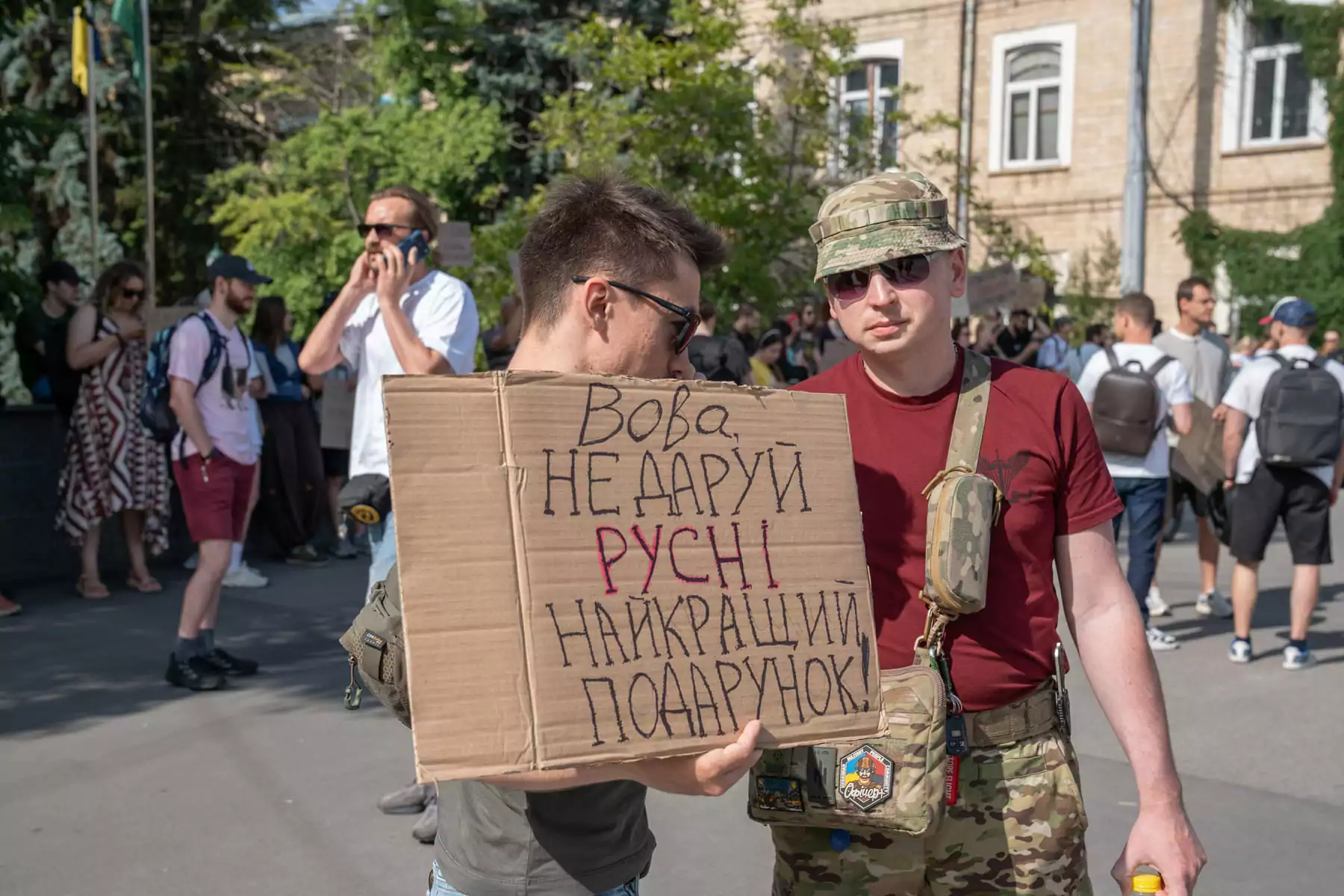
UKRAINE, KHARKIV, Jul. 16 — “I’m here because, over the last six months, we improved the way we destroy the Russian army, both in terms of quality and quantity,” Hlib tells Gwara’s journalists as the crowd of protesters around him shouts, “We’re against the dismissal of Minister Fedorov”.
On Jul. 14, the Cabinet of Ministers of Ukraine was dismissed along with Prime Minister Yuliia Svyrydenko. The next day, President Volodymyr Zelenskyy couldn’t clearly answer if Mykhailo Fedorov, the Minister of Defense who convinced Elon Musk to shut down Russian Starlinks, would be reappointed to his position. Later, Fedorov confirmed he was dismissed from the position of Minister of Defence.
That pushed people across different Ukrainian cities — and Hlib — to the streets. He is a veteran who voluntarily joined the army at the start of Russia’s full-scale invasion. He protested the law that compromised the independence of the state’s anti-corruption institutions almost exactly a year ago. Now, he’s holding a sign saying, “Why the fuck are you breaking something that works? #ISupportFedorov.”
Most of the soldiers we’ve spoken to about their thoughts on the dismissal of Fedorov weren’t in Kharkiv — they’ve been stationed at their positions across Kharkiv oblast. All of them have spoken anonymously, for fear of repercussions from the military command in their units.
Both Hlib and another soldier from an air defense unit, stationed in the north of Kharkiv oblast, think that Fedorov’s dismissal is connected to the minister blocking “someone’s corruption scheme.”
Fedorov has indeed talked at length about his zero tolerance towards corruption in the Ukrainian army, promising to jail “everyone who gets involved with corruption, schemes, or promotes private interests.” In the July 16 piece, The Economist journalists wrote that Fedorov’s financial audit of the Ministry of Defense and army brigades, one of the first things he did after assuming the position, uncovered overspending of $6.6 billion (300 billion hryvnias).
“Fedorov’s drone procurement campaign and the fact that he was managing things effectively led to more funds becoming available (economic efficiency) and quality improvement (of the operations). That shows how cool everything was. His dismissal is nonsensical,” an air defense unit’s soldier told Gwara.
The soldier added that the reforms Fedorov’s team had done and the way the changes increased the defense capacity “might have given us a chance to start talking about the victory in war with Russia instead of freezing the front along the zero line. Thanks to the minister, we were able to break the Russian logistics. We’re breaking it right now.”
“It’s a blow to our ability to defend ourselves,” an air defense soldier concluded, “a political decision that’s connected to the conflict with the Commander-in-Chief.”
Zelenskyy talked about systemic conflict between Fedorov and Commander-in-Chief of the Armed Forces Oleksandr Syrskyi on Jun. 15 — that’s how he explained his decision to dismiss the former.
In today’s briefing, Fedorov himself said that he proposed to replace both Syrskyi and the head of the General Staff, Andrii Hnatov, “if (Ukraine) wants to defeat the enemy asymmetrically, with minimal losses,” Hromadske reported.
Syrskyi’s reputation of being a ruthless and conservative commander who didn’t care for the lives of soldiers was amplified, in recent weeks, by Babel’s media investigation unveiling deaths during training in the Skelia assault regiment, which is considered to be subordinate to him.
But Zelenskyy didn’t want to replace Syrskyi. Fedorov said that, after his proposition, part of his initiatives started to be blocked — he believes that Syrskyi gave Zelenskyy an ultimatum to either dismiss him or Fedorov.
“Syrskyi isn’t ready to openly talk about the problems. But he’s ready to […] scheme,” Fedorov said.
Dmytro, another soldier, said that the possibility that Fedorov was dismissed because of his conflict with Syrskyi or his anti-corruption efforts in military procurement is what upsets him the most.
“I took it as a sign that ‘a small Soviet army’ has won inside our country,” Dmytro says, adding that this means uncertainty for the implementation of reforms the Ukrainian system needs.
Service members we’ve spoken with evaluated Fedorov’s reforms differently: one Special Forces Operation’s infantry soldier said it’s clear Fedorov didn’t understand the army’s internal mechanisms, as he didn’t have relevant military experience.
One of the major issues in the Ukrainian army is that there are no clear terms for the duration of service for those who didn’t sign a contract. Fedorov’s new contracts, introduced in June, promised terms for demobilization for those who’ve served since the start of Russia’s full-scale invasion but didn’t offer anything more to those who’ve been in the army since 2014.
Such rules, says a Special Operations Forces’ infantry soldier, create inequality between people who serve for a long time and those who’re just mobilized. She asks, “Tell me, why a draft dodger who was mobilized yesterday can sign the same contract, serve for two years, and retire — and I, someone who’s been serving for 10 years already, don’t even have that right.”
An infantry soldier also believes that Fedorov’s system doesn’t motivate those who’ve been serving in the Armed Forces for a long time. She says, “they only care for those who’s about to be recruited now. Those who’ve been in the army longer aren’t of any interest to anybody.”
The changes to defense ministers — there have been several of those in Ukraine — don’t influence the situation on the frontline much, she believes.
“Everyone does something on a political level, but no one does anything for soldiers, because it’s not advantageous for them.”
She tells Gwara that, when she asked what her fellow infantry soldiers thought about Fedorov’s dismissal, one asked, “Who’s Fedorov?”
“Syrskyi is the one who needs to be replaced,” she concluded.
Hlib, a veteran we’ve spoken with at the protest, agrees that Fedorov’s lack of military experience worked to his disadvantage. However, he believes that to be Fedorov’s only flaw, — and, in the six months he’s been in position to, he still tried, Hlib adds. Another service member, a commander of the FPV drone unit, also working in Kharkiv oblast, said the journalist’s question on his feelings towards Fedorov’s dismissal made him angry.
“He was the first Minister of Defense who did something useful,” he said. He added that he hopes that today’s protests will lead to Fedorov being appointed back to the position of the Defense Ministry. “Otherwise, I don’t see any political will or steps toward victory from the country’s leadership.”
Cover photo: “Vova, don’t give the best gift to Russians,” says a sign on the protests against the dismissal of Mykhailo Fedorov, Ukraine’s Minister of Defense. Jul. 16, 2026 / Photo: Gwara Media, Liubov Yemets
Hi, it’s Yana, Gwara’s editor-in-chief. We rushed to talk to soldiers about the Minister of Defense’s sudden dismissal because they are the most affected by these changes. Hope this text gives you a sense of how they feel. To support our journalism, please consider giving a $5 tip to our Kharkiv-based newsroom — it’ll be a huge boost to our security funds, which we desperately need since the city is now being attacked from FPV drones.
Read more
- Parliament appoints Serhii Koretskyi as Ukraine’s new prime minister amid protests over defense minister dismissal
- Fast and almost invisible. Why are Russian jet-powered Shahed drones harder to down in Kharkiv?


Subscribe to news from Kharkiv, Ukraine
Most important stories from the frontline region