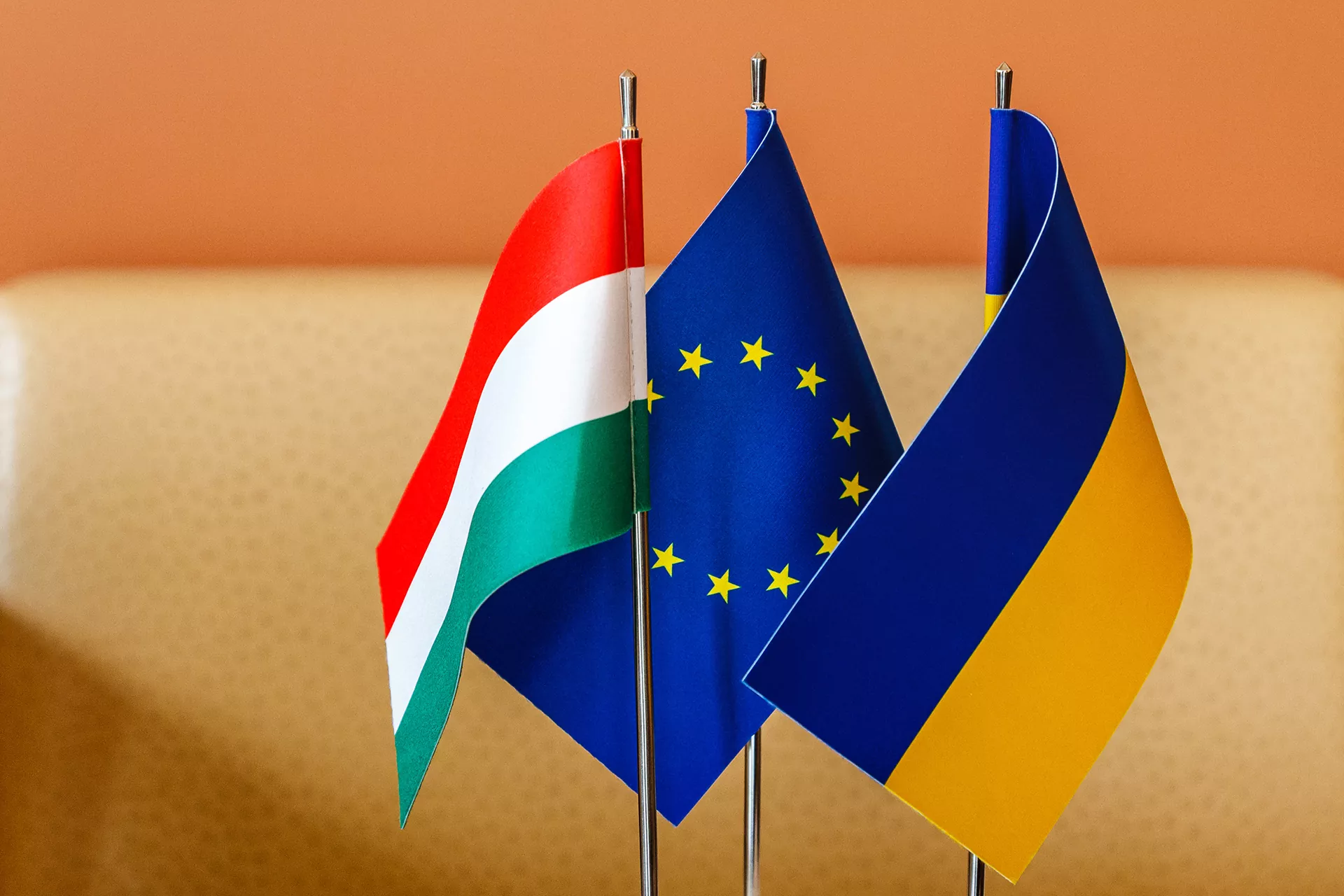
UKRAINE, Oct. 27 — On Oct. 20, during the meeting of a working group on the EU enlargement, Hungary, without explanation, blocked the fourth and fifth negotiation clusters for the European Union accession of Ukraine and Moldova, the Kyiv Independent reported, citing Ukrainian and European diplomats.
Seven days later, on Oct. 27, Hungary again refused to approve these negotiation clusters. European Pravda, a Ukrainian media outlet, reported that the Irish government, which holds the presidency of the EU Council, was aware that Budapest’s position had not changed. Still, the European Pravda’s source in the EU Council said that bringing the matter up for re-discussion was more political in nature and served as a tool to pressure Hungary, rather than a real attempt to unblock clusters immediately.
Despite the belief in Brussels and Kyiv that the electoral wave sweeping former far-right Prime Minister Viktor Orban from power would ease Ukraine’s accession talks, his pro-European successor, Peter Magyar, continues to complicate progress on some of Kyiv’s efforts to join the EU. For Ukraine and Moldova, accession is almost an ideological goal. So, why did Hungary block Kyiv once again and what can be done about it?
What are negotiation clusters?
Since 2021, Brussels has used a relatively new methodology to harmonize the legislation of candidate countries with the EU. It contains 33 negotiation chapters grouped into six clusters. The clusters aim to make negotiations more efficient, predictable, and politically focused. At the same time, it gives the EU greater oversight of candidates’ paths.
All six clusters aim to cover every major area of government policy — from taxation and employment to education and sustainability. Each cluster can be opened only with the agreement of all EU members.
The fourth and fifth, which Hungary blocked, deal with the most vulnerable areas of future integration with the European Union, including agriculture, energy, transport, and the green agenda.
On Jun. 15, Kyiv opened the first negotiation cluster, followed by the sixth cluster on Jul. 14. Four months later, on Oct. 13, Ukraine and Moldova unlocked the second and third clusters, which Hungary also blocked. Ukraine “unlocked it” after the Ukrainian Parliament satisfied Budapest’s requirement about strengthening the rights of the Hungarian-speaking minorities in the country and passing the corresponding law.
Why Hungary blocked Clusters 5 and 6?
Magyar’s arrival didn’t radically change relations between Budapest and Kyiv, Ansatasiia Datsiv, Advocacy manager for European integration at Zmina, a Ukrainian human rights organization, said:
“Of course we can see progress, including the opening of four negotiation clusters. But the important thing is that еhe start of Ukraine’s accession to the EU received the “green light” from Hungary as far back as the Fidesz government under Viktor Orbán.”
Long-established views of Hungarian society influence how the parliament handles its foreign and domestic policies, Datsiv said.
At the same time, she continued, Magyar began his political career as a member of Orban’s Fidesz party, spending many years in public service. He also repeatedly said that, for him, Ukraine’s accession to the EU isn’t guaranteed but will depend on how Ukraine implements the reforms, as EU membership is still a merit-based process.
Datsiv also noted that Hungary provided no explanation why it blocked clusters 4 and 5. According to her, Rumor has it that the Hungarian diplomats’ decision is once again based on domestic political considerations.
“Since clusters 2 and 3 have only just been opened, the Hungarian authorities need to avoid hasty decisions so as not to provoke a disconnect among the population or the other political movements.”
At the same time, it’s impossible to negotiate about joining the EU without Budapest’s agreement.
Datsiv said that the greatest lever of influence is the EU’s release of Hungary’s funds under various programs. On May 26, the European Union blocked 16 billion euros in funding for Hungary because Orban blocked funds for Ukraine. However, she added that this decision also depends on Hungary’s internal progress.
What’s left to do
When asked how realistic it is to resolve the remaining negotiation clusters by the end of 2026, Datsiv said that this process typically takes three or four months, which makes the unblocking of the fourth and fifth clusters by the end of the year a rather unrealistic scenario.
However, it’s still unclear for Ukraine which reforms need to be implemented to “satisfy” Budapest — so it is even more difficult to estimate the chances of opening clusters by the end of the year.
“What Ukraine definitely needs to do is fulfill its EU accession obligations, particularly those outlined in the road maps of EU accession,” Datsiv said.
She added that Hungary will make its decision in due course, but implementing all planned measures before that decision is made can only help accelerate Ukraine’s access to the EU. Datsiv said that the European Commission assesses Ukraine’s progress independently of the position of individual EU actors.
The European Commission’s annual enlargement report is expected to be published soon, so given Hungary’s veto, a positive assessment would be particularly significant, as it would weaken Budapest’s argument that Ukraine has made no progress on the first cluster, Datsiv concluded.
Read more
- Freedom square in Kharkiv (Svobody square): myths, facts and symbols
⛈️ Winter is coming, and, for Ukraine, it is predicted to be awful. Please support our Kharkiv-based newsroom with a $5 coffee to help us withstand whatever Russia has prepared for us.


Subscribe to news from Kharkiv, Ukraine
Most important stories from the frontline region