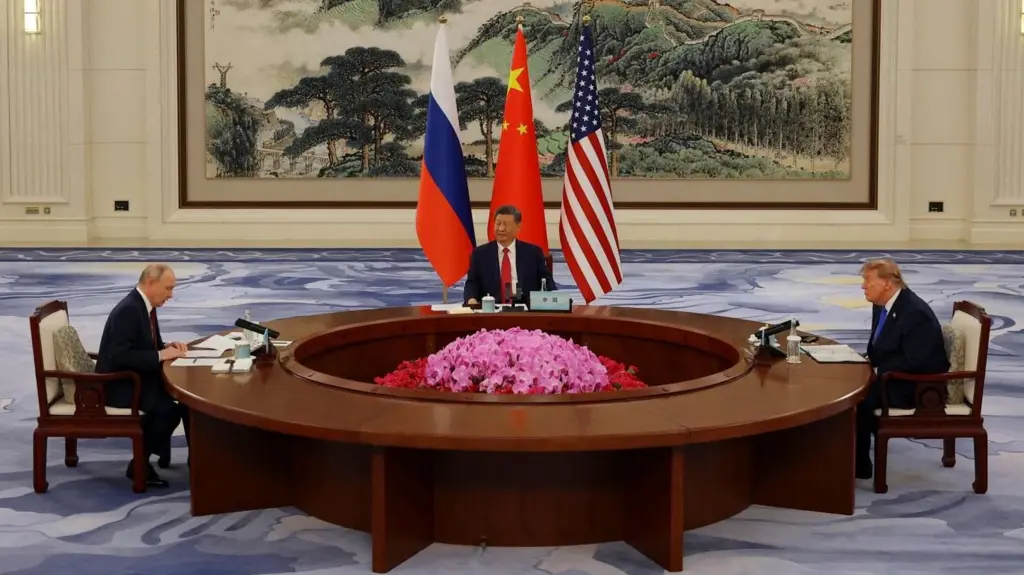
Nov. 19 — Yesterday, a Russian journalist asked President Vladimir Putin of Russia whether the trilateral meeting between him, Chinese President Xi Jinping, and President Donald Trump of the United States looks like “Yalta 2.0.” Putin nodded.
The meeting was held in Shenzhen, on the sidelines of the Asia-Pacific Economic Cooperation (APEC) summit — and Ukraine was especially concerned about its outcomes. On the eve of the Shenzhen talks, Andrii Sybiha, the minister of foreign affairs of Ukraine, said that Kyiv hopes leaders won’t backbite Ukraine, while Xi and Trump will put more pressure on Putin to force him to end Russia’s war in Ukraine.
However, for Washington (and Ukraine that relies on the US’s support), the trilateral meeting ended with modest results at best, with no signs that Trump tried to hold Putin accountable. At the same time, the talks demonstrated that Trump seems to respect Putin’s interests and is unwilling to side with Taiwan, which aligns with Xi’s ambitions.
Trilateral meeting
For some, it was hard not to draw the parallels with the Yalta Conference in 1945. Once again, three leaders of the largest military powers gathered in one place, amid speculations about another division of the world into spheres of influence.
Trump’s “historic meeting” lasted about 90 minutes.
The US President also held the 40-minute talks beforehand. The Kremlin confirmed that Trump and Putin discussed how to end Russia’s war in Ukraine. Right before the meeting, Xi talked about the responsibility of three major powers to maintain global peace and stability.
But Xi’s words were not backed by action. The continuation of Russia’s war in Ukraine and subsequent isolation of Moscow has always worked in China’s favor, said Iryna Khalova, the senior analyst specializing in Asia at ADASTRA, a Ukrainian independent think tank.
Since Russia’s full-scale invasion of Ukraine in 2022, China has become the most important and one of the most open markets for Russia, especially in energy exports. At the same time, China has become a major supplier of goods to Russia, including cars and industrial equipment. In 2025, Beijing has supplied Moscow with more than $13 billion worth of vehicles.
Khalova also said that XI has an interest in Russian military technologies and experience in the war with Ukraine.
But for Xi hosting the American and Russian presidents in Shenzhen provided an opportunity that laid beyond the trilateral meeting. Bringing two political rivals to the table presented China as a stable global power.
The meeting was also held at the very period when President Trump entered his lame-duck period after the November midterm elections, when the Democrats swept the Republican Party out of both chambers of Congress. Khalova said that Beijing may use political chaos in Washington to strengthen its own diplomatic position.
“One hypothetical scenario could be an agreement at the Trump-Xi level that would grant China complete freedom of action in Taiwan and the Indo-Pacific region in exchange for certain concessions to Moscow in Ukraine,” Khalova said.
Declaration on peace without Ukraine, Taiwan
The major agreement of the meeting became a four-point declaration, pledging to reform the United Nations, increase supplies of refined petroleum products, maintain stable energy flows, and continue talks on reducing nuclear risks.
Putin gained a special benefit in the declaration. In the text, leaders called for immunity for state officials and warned the International Criminal Court (ICC) against abusing its jurisdiction. Since the 2022 Russian President is wanted over alleged unlawful deportation of Ukrainian children from the Russian-occupied territories.
Neither Taiwan nor Ukraine was mentioned in this document.
At the same time, Khalova said that an agreement on energy supplies could create risks for Ukraine. Trump can use it to put additional pressure on Kyiv over Ukrainian strikes at Russia’s oil refiners.
A new Yalta?
“Yalta 2.0 didn’t happen,” said Oleksandr Kraiev, director of the North America Program at the Ukrainian Prism Foreign Policy Council, another Ukrainian think tank.
He also said that Washington had largely abandoned its earlier efforts to make China take a more active role in ending Putin’s war in Ukraine.
The differences between Russia, the US, and China and the lack of stable strategic relations make any significant agreements impossible, he believes.
Nevertheless, for Putin and Xi, the summit became an opportunity to project international influence without making any substantial concessions.
“So, for now, the trilateral meeting played out as a public relations and media story involving two dictators and one president who would like to be a dictator,” Kraiev said.
Hi, this is Nazar, the author of the article. We are launching a new vertical on international policy, aiming to put Ukrainian voices on the international stage. If you want to support our journalism, please buy us a coffee or become a long-term subscriber.
Read more
- Blue Wave sweeps Republicans out of power in Congress. What does it mean for Ukraine?

Subscribe to news from Kharkiv, Ukraine
Most important stories from the frontline region