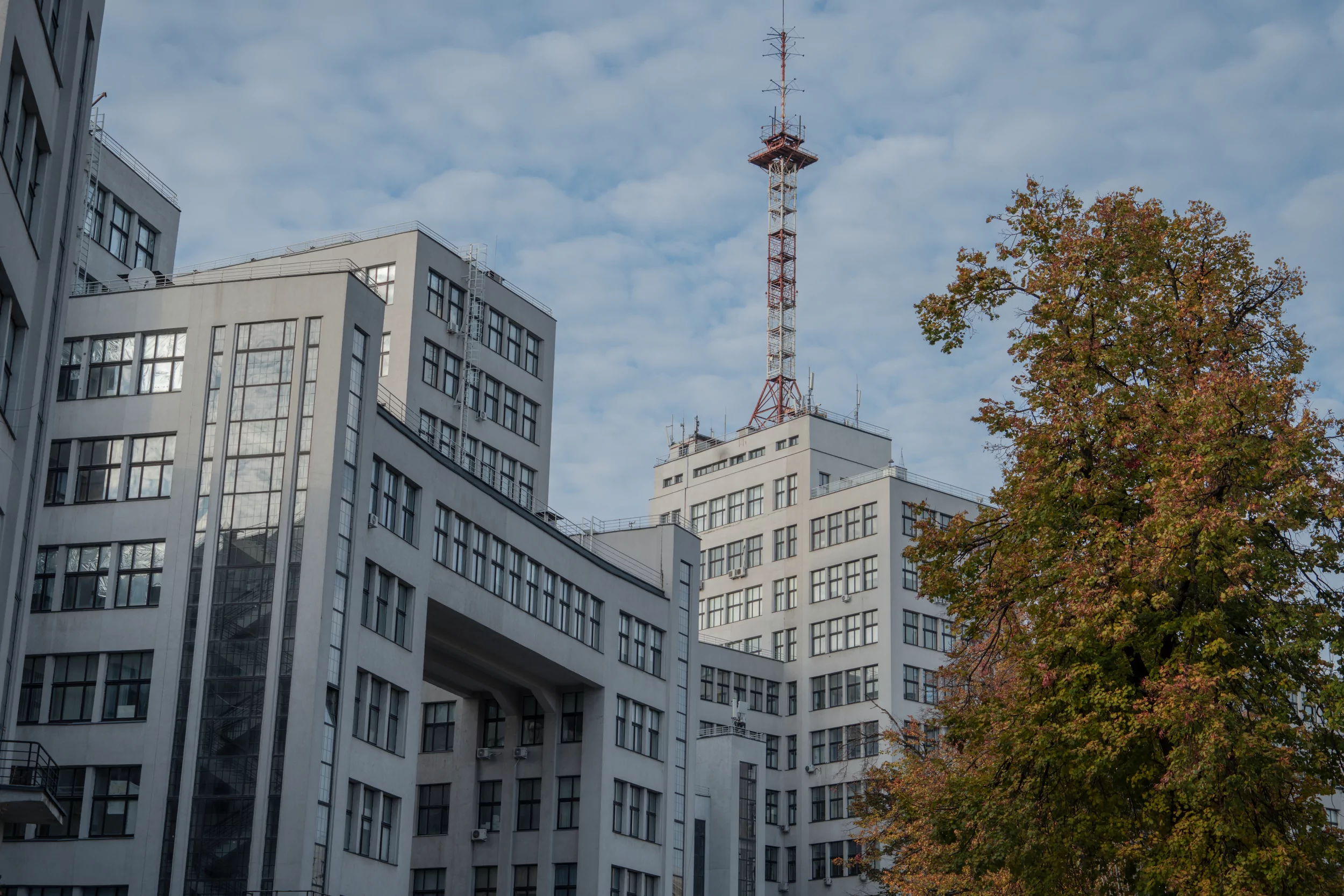
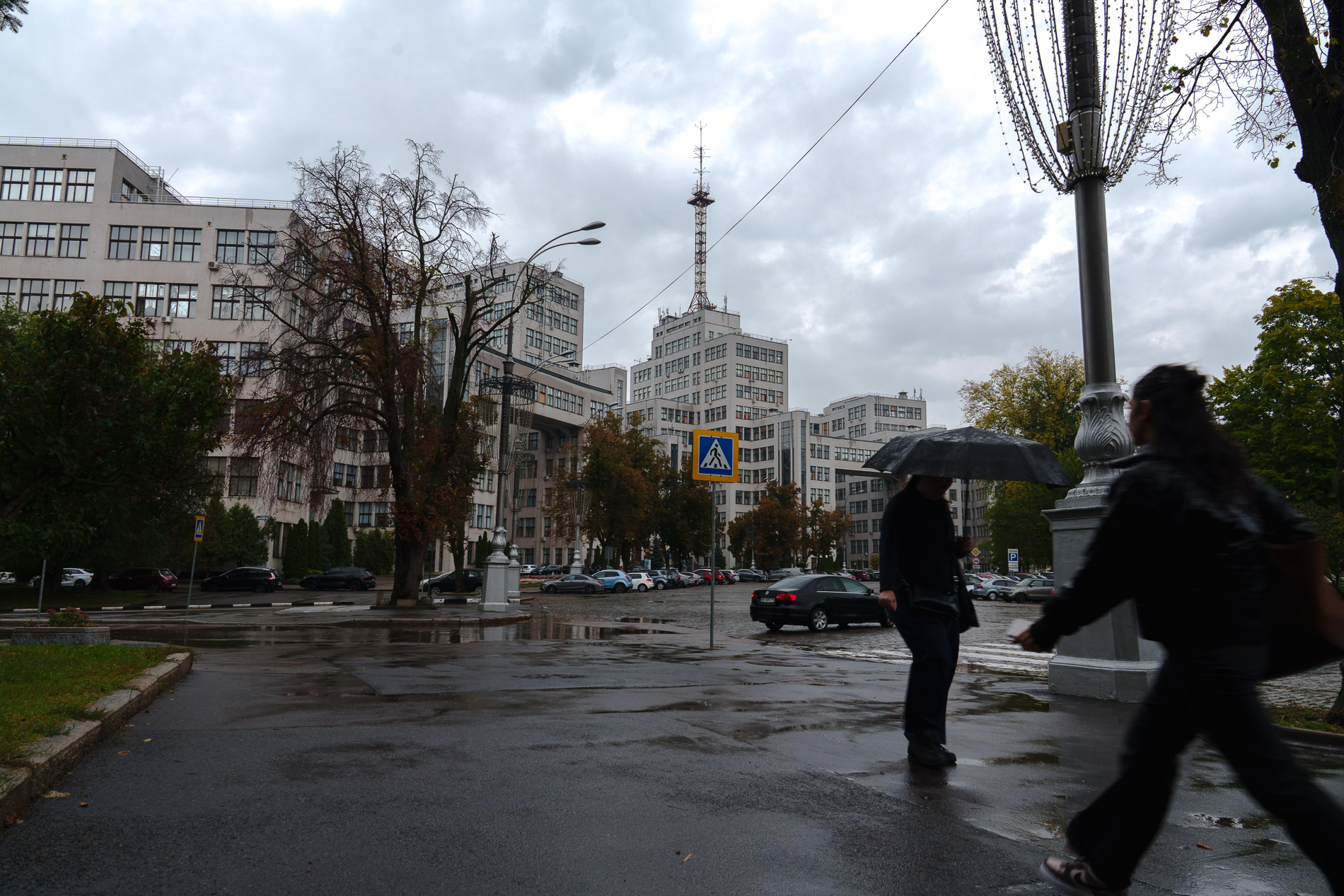
I stand in front of Derzhprom, in the very heart of Kharkiv. Concrete bridges pass through the air joining the huge towers that rise up to the height of 63 meters above Freedom Square. The building dominates its surrounding space. Everything is challenging gravity.
From afar, Derzhprom looks like a giant machine. Up close, the building appears alive.
Like a spider sitting right in the center of the giant web, it spreads its concrete limbs above the square. From the center, the threads of Kharkiv Modernism reach throughout the city: residential areas for workers, factories, clubs, educational facilities, department stores, cinemas, hotels, cultural centers, entire districts built in the belief that architecture could create a new society. Derzhprom was supposed to be the nucleus of the new body for this society to live in. That is why Soviet authorities decided to build it here.
For centuries, Kharkiv was one of Moscow’s key gateways to expand its influence to eastern and southern Ukraine. Under the Russian Empire, Kharkiv was a city of administration, army, education, and industry that could help Moscow connect with the Slobozhanshchyna (regions of Kharkiv, Sumy, and Luhansk), Donetsk and Luhansk regions, Crimea, and even Caucasus.
Kharkiv’s location was useful for that.
In 1919, after Bolsheviks occupied Ukraine during the Ukrainian War of Independence, they called Kharkiv the capital of Soviet Ukraine. The decision had little to do with any Ukrainian statehood or sovereignty. It was pragmatical. Kharkiv was the largest Ukrainian city that Bolsheviks could easily control and use to administer the territories they had conquered. Kyiv, by contrast, was disputed territory during revolutionary years and only then integrated into the Soviet power.
Kharkiv’s new political status demanded its new skyline. As the city had to represent the new status of a capital, it needed a new architectural language.
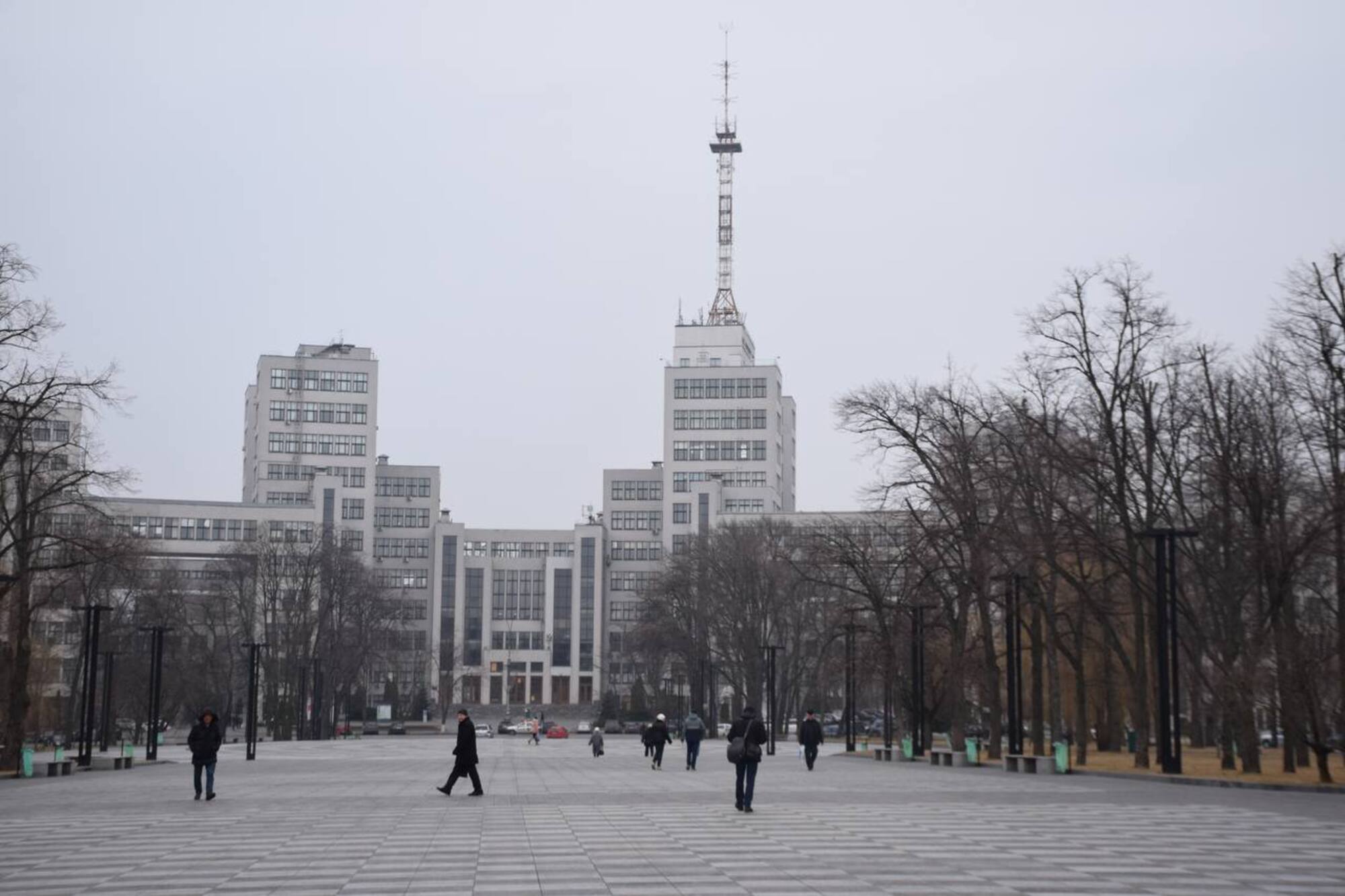
Built in 1928, Derzhprom, also known as the State Industry Building or Hosprom, was the first Soviet skyscraper. It consisted of more than 60,000 square meters of floor space. Built only of reinforced concrete without any steel structure, it was one of the most advanced buildings in Europe in its time — the physical manifestation of the new political order that had come.
And the paradox of Derzhprom is that it has outlived the ideology that commissioned it.
Originally created as an expression of the power of the Soviets, the building transformed and acquired a new dimension. With the passing years, the architectural language of this skyscraper spread all over Kharkiv not only as propaganda but as the architectural heritage of the city. Today, despite its Soviet roots, Derzhprom building is increasingly recognized as a part of the architectural heritage of Ukraine, which was created by architects from Kharkiv and was influenced by their engineering traditions and history.
According to local architect Oleg Drozdov, there were several waves of modernism in Kharkiv. The first wave – and the most powerful one – took place when Kharkiv was the capital of Soviet Ukraine. At that time architecture, housing, infrastructures and public spaces were perceived as an integrated modernist urban concept. This made Kharkiv one of the most progressive laboratories of modernist planning in Europe.
With its move in 1934 from Kharkiv to Kyiv, the Soviet government deprived Kharkiv of the political weight which allowed it to build at an incredible pace. According to Drozdov, this was a crucial moment in the history of architecture in Kharkiv.
“Kharkiv went from being the republic’s principal city to becoming, comparatively speaking, a second one,” he says. “From the 1920s to the 1980s, the level of funding and investment steadily declined.”
However, modernism did not leave Kharkiv but it changed the form. Spider of Derzhprom stayed in the middle of its web, but the web did not grow with the same pace anymore.
This second wave occurred during the post-war years, mostly in the 1960s. Unlike grand administrative edifices, architects became interested in the lives of people: they started constructing cinema theatres, concert halls, hotels, cafes, educational establishments, cultural centres. Ukraina Concert Hall, Mir Hotel, Cafe Crystal and many other civic buildings reflected the essence of modernism that was no longer triumphant but rather humanistic.
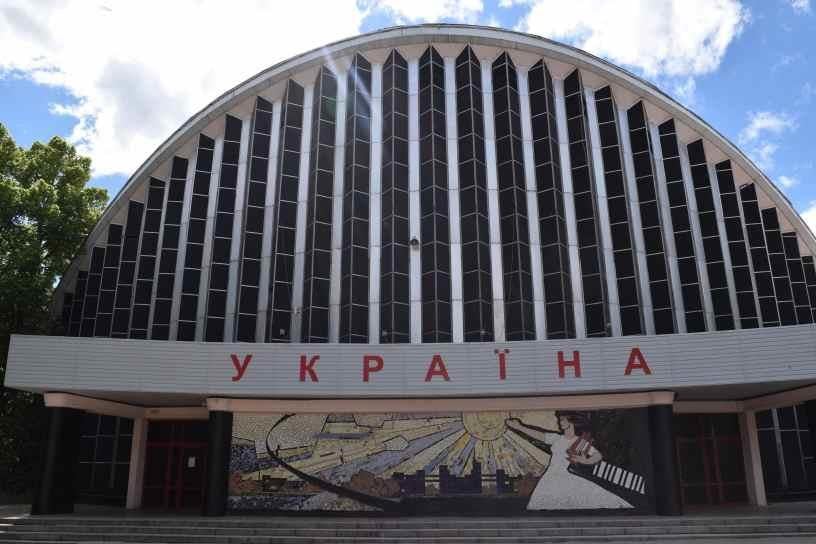
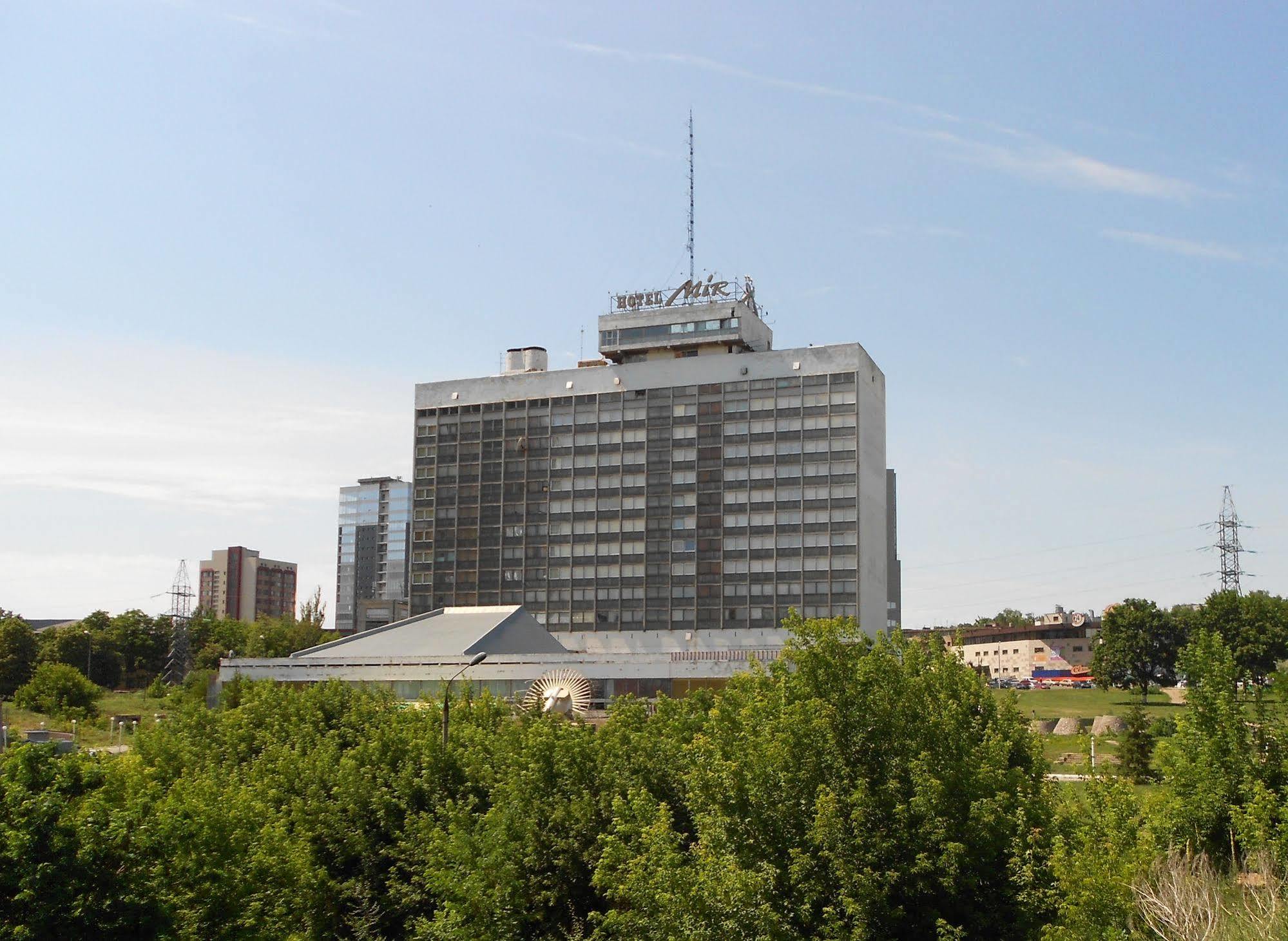
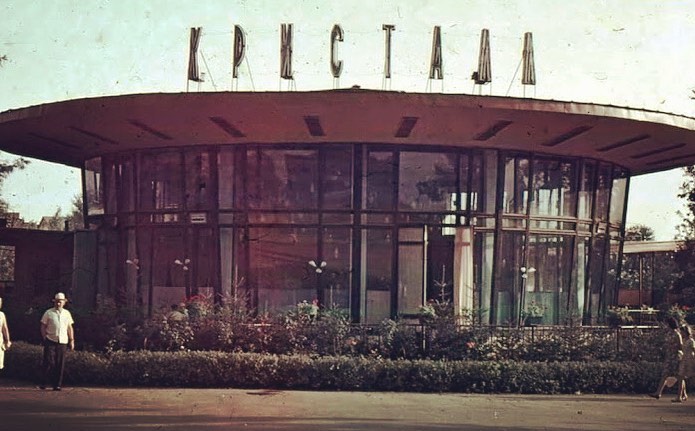
Kharkiv’s architects had to adapt to the new financial and political circumstances. Scarcity sometimes brought about new creativity, quiet, inventive and resourceful architecture.
The third wave came in the 1970s and early 1980s. It coincided with the rapid expansion of Saltivka, one of the biggest prefabricated residential zones in Europe. Soviet authorities intended to build more than 400,000 houses in one district. That’s more than the total population of some of Ukraine’s big cities like Poltava.
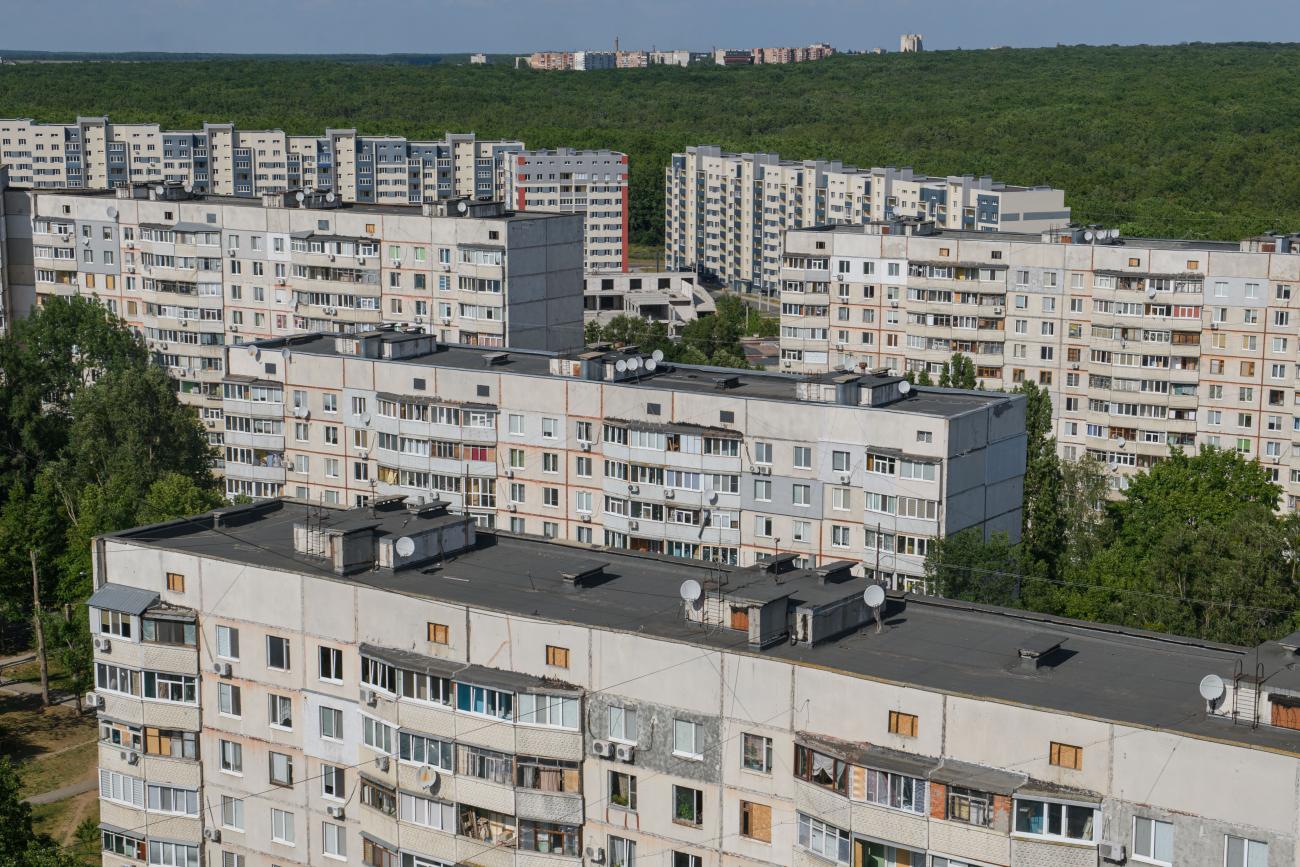
While Soviet mass housing has always been considered to be nothing but monotonous, anonymous, and soulless, in Kharkiv even the usual planning scheme was subjected to architectural experiments. Neighborhoods were being developed near shopping malls, cinemas, squares, transport facilities and parks structures, including Ukraina department store and Rossiya Cinema (currently known as KinoLand). This proved that architecture could retain its creativity despite the growing standardization.
Modernism was the concern of a certain decade or generation in other cities. But Kharkiv managed to build up a series of architectural experiments during more than half a century. From the extreme constructivism of Derzhprom, through optimistic modernism of the 1960s, to the ambitious urbanism of Saltivka. Thus Kharkiv became the living repository of the entire era of twentieth century modernism.
For many years, this repository has been described only using the vocabulary of Soviet history, with its constructivism, industrialization, socialist urban planning, architectural language. This vocabulary is not wrong, but it is incomplete. It deprives Kharkiv’s architecture of its context, the environment which made it possible and which partially commissioned it.
Architectural historian Yevgeniya Hubkina argues that this reduction was not just about aesthetics. It had also historiographical implications: who had the power to name, classify, and claim the architectural heritage of this city?
For years, she says, Ukrainian researchers tried to fight the colonial practice of describing Ukrainian modernism inside the broad Russian imperial landscape. This was not an artificial attempt to nationalize architecture; the Ukrainian nature of Kharkiv modernism, she insists, was evident even in the architecture itself.
“It was inherently Ukrainian,” Hubkina told me.
For her, the roots of Kharkiv modernism did not begin in Moscow. They grew out of Slobozhanshchyna, from Kharkiv’s own architectural and educational institutions, from the Polytechnic and the Technological Institute. Its history reached back to earlier local traditions of architectural teaching. In her view, Derzhprom and the constructivist city around it were not just the imported products of Soviet ideology. They also resulted from the work of the local architectural schools that had developed for generations.
This distinction is crucial. Saying that Kharkiv modernism is “Soviet” is describing the political system under which it was built. Saying it is Ukrainian is to define the cultural, educational, and intellectual environment in which it was created.
(Hubkina takes this idea even further. She claims that Kharkiv modernism can be understood as a continuation of the longer Ukrainian architectural tradition. Even the earlier classicism of the city, she suggests, cannot be viewed just through the imperial perspective. Behind these official styles, she sees the persistence of the local Baroque tradition and regional architectural thought.)
If we accept that Kharkiv modernism is inherently Ukrainian, the false border between interwar constructivism and postwar modernism disappears. According to the Russian historiographical tradition, architecture of the 1920s was often isolated as “avant-garde” or “constructivism,” while architecture of the 1960s and 1970s is considered as the separate Soviet modernist phenomenon. Hubkina rejects this division. For her, constructivism was just one branch of interwar modernism; postwar modernism continued many of its ambitions via new generations of architects.
One of the brightest pages of Ukrainian culture unfolded in the modernist Slovo Building in Kharkiv (translates to “Word” in English). It was there that some of the greatest Ukrainian poets and writers gathered under one roof, until the Soviet regime banned them. Most of them were arrested, sent to exile, imprisoned, or executed, one after another. Those artists are now a part of what’s called the Executed Renaissance.
Hubkina remembers talking with Plaksiy, one of the leading architects of the 1960s and 1970s of Kharkiv, who saw himself as a follower of Ukrainian constructivists of the 1920s and 1930s. He remembered his teachers who spoke Ukrainian, architects related to artists of the Berezil theatre (founded by playwright Les Kurbas who was, indeed, executed), and the cultural environment where architecture, scenography, industrial design, and Ukrainian artistic modernism were closely related.
Ukraina Concert Hall is one of the most explicit examples of this continuity. Formally, it belongs to the language of international modernism. Its name, its mosaic and the ideas behind it have distinctively Ukrainian cultural aspirations. According to Hubkina, the architects and artists behind this architectural project believed that a new renaissance of Ukrainian culture was possible, rebirth after the destroyed bloom of the 1920.
This makes Kharkiv modernism politically complex but culturally important. Many of its buildings were commissioned by the Soviet state, and some were built to satisfy the administrative needs of Soviet power. However, the people who created them did not work under Soviet ideology only. They belonged to Kharkiv. They inherited local traditions, studied in Ukrainian institutions, were inspired and advised by artists, theater-makers, engineers, and teachers.
That is why to recognize Kharkiv modernism today does not mean to deny its Soviet context. It means to refuse to let this context dominate over the entire story.
The Russian war against Ukraine has made such a recognition even more relevant. When Russian missiles strike Derzhprom, the Slovo Building, residential constructivist districts, or Railway Workers’ Palace of Culture, they are not only destroying “Soviet architecture.” They are demolishing the material heritage of Ukrainian modernity, the material evidence of the city that imagined itself as a place of industry, education, culture, experimentation, and public life.
To save Kharkiv modernism, then, is not to save nostalgia for the USSR. It is to protect a Ukrainian heritage that was misnamed, misread, and appropriated by others.
In October 2024, a Russian glide bomb struck Derzhprom, destroying its concrete body and damaging one of its entrances. The windows were broken across its facade. The walls, ceilings, and interiors were damaged. A building that had survived almost a century of political regimes, urban transformations, neglect and wars suffered a symbolic damage.
Russia constantly declares its love for the Soviet past. They use Soviet symbols, myths, cults of the victory in the war, and architecture as the part of imperial nostalgia. They try to claim Kharkiv architecture as part of their own imperial narrative. However, once this city resisted the occupation, Russia’s attitude to the supposedly “shared heritage” has changed. When Russia looks at Kharkiv today, it does not see the heritage. It sees the city that defied imperialism.
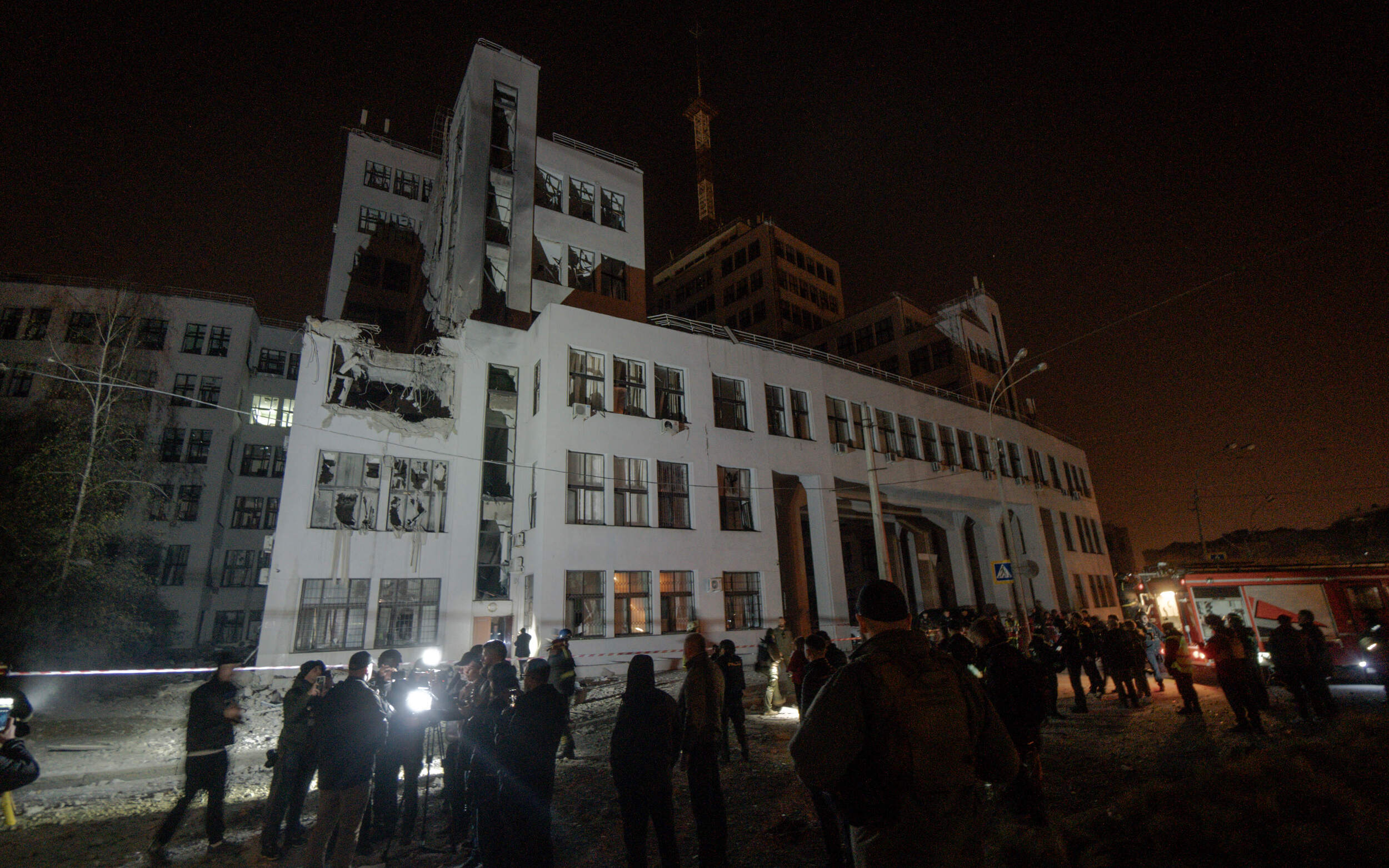
Looking now at Derzhprom, one sees not only the history of Ukrainian modernism but also the violence of the actions produced by Russian imperial memory. Russia does not want the past to survive unless it controls its meaning. It does not want the monuments to remain standing if they prove that this is the Ukrainian city, Ukrainian society, and the Ukrainian future.
Derzhprom still stands.
Its concrete bridges are suspended above Freedom Square. Its towers still face the city. Its damaged entrance became the new page of its history, not the final one. The spider’s web did not vanish. It still extends throughout the city’s streets, its ruined and surviving buildings, memories of architects, locals, historians, and those who continue to say that this heritage does not belong to Moscow and the Soviet past alone.
…you’d like to support my journalism and help us produce more stories like this, you can treat Gwara to a coffee or become a regular subscriber.
Hi, this is Nazar. I was very happy to write this article because I love my city and am always glad to share what I know about Kharkiv with you. If you’d like to support our newsroom and help me produce more stories like this, you can treat Gwara to a coffee or become a regular subscriber.
Read more
- Kharkiv wartime travel guide: what to see and do 12 miles from front line


Subscribe to news from Kharkiv, Ukraine
Most important stories from the frontline region