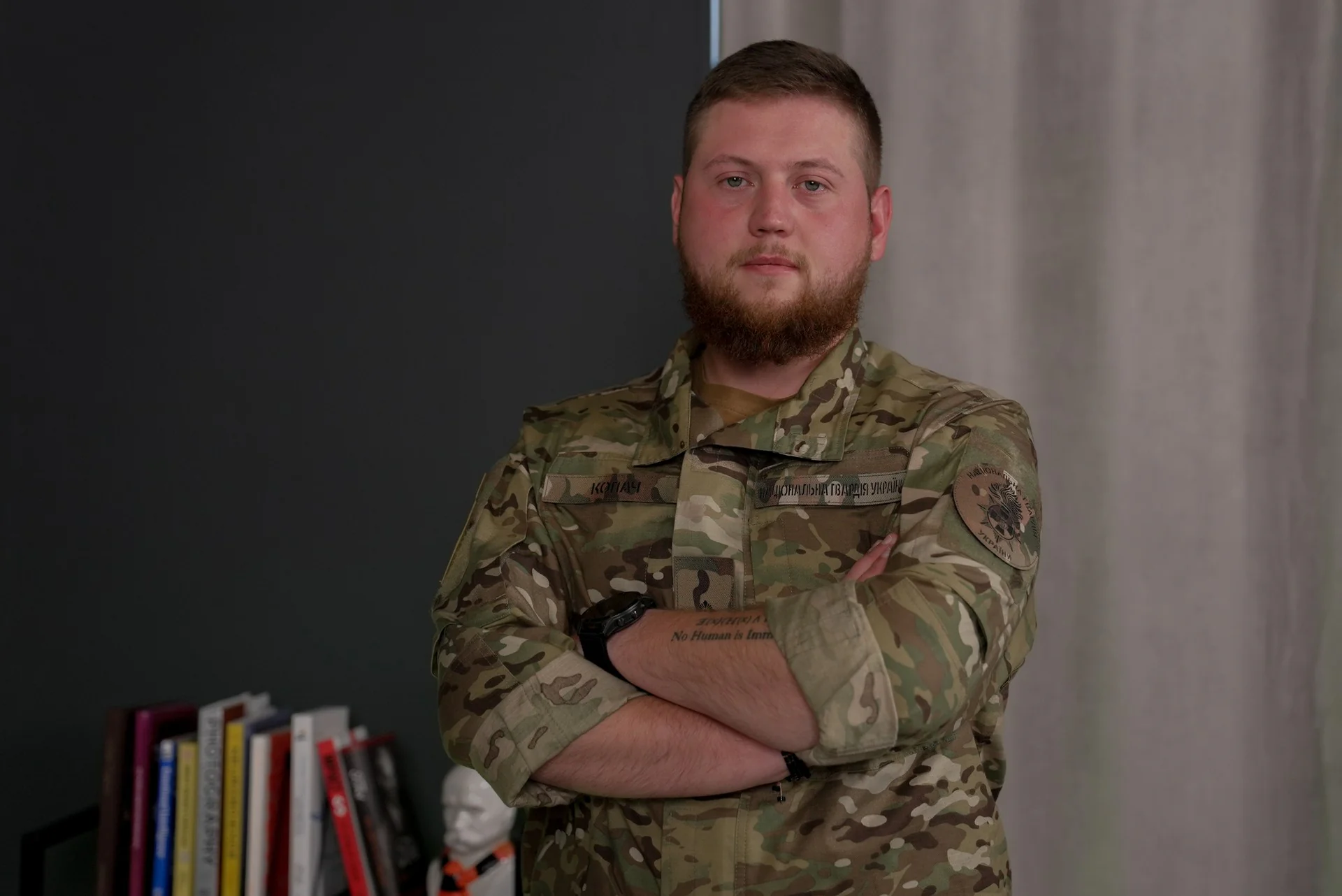
Last time, we talked to soldiers who’d later become part of the Lava military unit in 2024. In December back then, they added ground drones to the Khartia brigade’s assault operation for the first time ever. Two years later, Lava, now an unmanned systems regiment of the 2nd Army Corps, conducted its first logistics mission using an AI-powered ground drone. For 93% of the route, the drone was moving autonomously.
We’ve talked to Andrii Kopach, call sign Mathematician, about the advancement of ground drone technologies in Ukraine, their cooperation with German Apex AI, which developed an AI model for their drones, and the challenges, both from Russian troops and the Ukrainian defense industry, that the ground drone field is facing.
The interview was shortened for better readability.
Two years ago, your colleagues told us that there was no mass production of ground drones. Now, Ukraine’s defense ministry reports on 100,000 missions being conducted just in 2026. What changed over these years? What prospects and limitations for this field exist nowadays?
A lot has changed, especially in our unit. The scale of ground drone usage increased, their models changed, application tactics changed, as well as the ways Russians counter these drones.
Our unit advanced the implementation of ground drones in logistics the most. They have even been through an iteration. We believe that the majority of the ground drones that are currently used belong to the old generation. They can only achieve a speed of 8-12 km/hour (~5-7,4 mph). They don’t have a chassis and can’t move smoothly like a buggy or a car. It’s just a brick on wheels.
Technologies for connection and management of those missions have also improved, as well as the organization of missions. It’s simpler to improve those for logistics, but even there we need additional tools and technologies that help operators do things when there’s no connection. Currently, our main connection tool is Starlink. But we have to research other technologies that would achieve goals Starlink achieves at least partially.
What didn’t change as much is assault missions; they’re challenging to plan for, and you have to account for weather conditions and the situation on the ground. But technologies for assault missions are advancing.
Foreign companies work on ground drone development daily, but many of them don’t understand the reality of using them on the ground, the specifics of the environment in which they will be used, and which functions will and won’t be efficient. That limits both companies and military units collaborating with them.
We try to solve that a little. That’s why we created this first minimum viable product (MVP), our AI-powered ground drone. That’s a technology from Apex AI, a German developer, that helped us conduct this first half-autonomous mission. Soon, there will be more missions like that.
Tell us about your collaboration with Apex. You said that you worked very tightly with the developers so that they, as far as I understand, understood the use cases and the environment in which the ground drone will operate.What things did you have to explain to them, what wasn’t obvious?
Collaboration with developers is the biggest part of the challenge — not picking technology, making calculations, or manufacturing. We worked with them for three months in total. They didn’t understand how the ground drone moves at all. Because within Germany, it was difficult for them to test it: they had to get a license to be able to move on lawns, in forests, maybe in parks. If they were to move out of the city, they had to get another license.
So they didn’t understand how a ground drone moves in various conditions, where a challenge might occur. For instance, how would a drone move if there were rails in front of it or puddles around it? Would it get through them? If so, how should it do that? Only ground drone operators with real-world experience could have told them that.
Note that our goal isn’t to make every logistics mission autonomous, but to make a small step: to create an AI-powered drone that would complete 20-30% of logistical tasks in a zone a unit is responsible for. That would have allowed us to reduce the number of operators on these routes. Access locations where Starlink doesn’t work. Simplify preparations for these missions and simplify the missions themselves. This technology has a lot of pros.
We had a productive collaboration with Apex because they physically came here. There are many companies that think they can collect feedback, a letter, a document, and then deploy the product in Germany. In Europe, they say: “Let’s do a videoconference. You’ll talk, you’ll tell us what’s wrong.” We sit with them for an hour and a half if there’s time. We’re listened to. But that’s just part of the process. They have to come here and see what really works and what doesn’t. It’s that simple.
This ground drone made it through 93% of the route autonomously, and the operator took control for just 1.4 km (~0.8 miles). Are operators just resting during this time, or are they looking for possible threats around the drone?
The operator certainly doesn’t go to drink coffee when they’re on the mission. If there are additional sensors or microphones, they can listen for Russian drones and track threats. Mainly, they are focused on the mission: although they don’t control the drone physically, they should be ready to jump in at any time, like in the case of this mission.
You shouldn’t think that it’s some incredible magic. This mission didn’t take the most complicated route ever. It was an average task, I would even say banal. Our operators control ground drones in much more complex environments. The route had asphalt roads and dirt roads, different obstacles, but it’s not the most challenging route an AI can deal with. It’s not about that.
If we’d really sent this ground drone on a route where everything is mined and can be ambushed by Rubicon (Russian highly skilled drone unit – ed.), that wouldn’t give us information about the system. The system’s job is to reach a certain territory. Ours is to see what speed it can achieve without losing efficiency.
Of course, when AI-powered ground drones that can complete simple logistics missions are scaled, operators would have more time for different tasks that would improve mission quality. But it’s hard to say how soon that would happen.

You said that evacuation missions can yield the most benefits from AI-powered ground drones. What barriers exist for that to happen? How soon can Ukraine integrate this technology for evacuations?
Evacuations themselves have changed. In the past, we’ve been evacuating people on those bricks-on-wheels-type drones. It doesn’t feel very nice to be carried on that, especially if a person’s injured, but if that’s the only option, we had to do it. Now, missions like that are very challenging to conduct because of how slow these ground drones are. On some sections of the frontline, I am simply unable to do evacuations using them — Russian troops spot them and destroy them in seconds. We won’t even reach the wounded.
That’s why we work on the next generation of ground drones, robotize the existing chassis, etc. They’d be faster than existing ground drones, reaching 20-30 km/hour (~12-18 mph) and more. But these have limitations too – of connection, operator’s experience, and so on. But that’s the main concern for evacuations.
For ground drone evacuations to happen, you’d have to not add AI, but make the ground drones themselves faster?
Yes, they have to move faster, but AI, we hope, will help us to evacuate people at that speed — because controlling a fast ground drone with the existing connection issues and without AI is very difficult, practically impossible.
You mentioned that Russian troops detect ground drone evacuation missions very fast and attack them. And we know from sources in the military that the number of cases like this has increased. How much did the situation worsen?
Everything depends on which military units, e.g., Rubikon, are present on the axis and what assignments they have. Because Russia has units that are specifically tasked with attacking logistics and ground drones, they create ambushes, destroy equipment, and, in general, aim to worsen the situation. In general, things did get more difficult, so we should expect and counter that.
While I’m certain that the future is the underground war, technological advancement can still happen on the ground, and it can be advantageous. For instance, the idea of an active defense complex that detects Russian drones and neutralizes them. In a complex like that, cameras and microphones detect drones, and anti-drone net guns and shotguns shoot them down. Technologies like this exist in different variations now. Lava works on its own prototype.
Are you talking about a device that can conduct a logistics mission and is capable of downing an FPV drone?
More about a module that can be installed on a ground drone, military equipment, armored vehicles — everything that moves. Its goal is to protect them from Russian drones. With a module like this, evacuation, complex logistics missions, and combat missions will get easier. It’s hard to say how efficient these can be exactly, I’d need data for that, but if technology like this scales, assaults with heavy equipment will come back. And again, that can change the balance of power on the battlefield. But Russians are openly working on this technology, too.
Let’s talk about the quality and quantity of ground drones, then. Right now, the state procures far more ground drones than two years ago. Your colleagues told us that all ground drones entering the military require additional modifications. And before the interview, you mentioned that they are expensive. Tell us more about that.
I have to say, things are still better than they were a year ago, but the issue of cost doesn’t disappear. If we were to compare a small ground drone and the automobile industry: a very good, relatively new car, maybe even a pretty one, will cost like a small ground drone that is not very fast and can’t move through rough terrain. It’s an issue concerning manufacturing, infrastructure, and the way the work of manufacturers is organized in Ukraine. It’s their pain, and it is very difficult to address.
That’s why I say that using ready-made chassis from buggy and quad bikes could simplify the thing and reduce the cost of ground drones.
As for the problem in general, there are many units in the Armed Forces that work with ground drones. But these ground drones comprise a zoo of different issues. And, yes, right now, many ground drones still need to be completed or modified, but that’s not the same situation as it was two years ago. These ground drones often arrive in the military with ready-made electronics and equipment for connection. It’s easier to improve them.
There’s also a complex structure of how ground drone procurement lists are formed. From the moment this list is created to the moment when ground drones arrive in the military unit that ordered them, the ground drones would most likely lose relevance.
How long does it take for them to arrive?
It depends. Sometimes three months, sometimes eight.
Is that a military organization issue or supplier’s issue?
It’s neither. The system works like that, and it’s hard to fix — it’s not about somebody doing their jobs badly. Abroad, things like this take years. Organizing something in a few months, buying equipment for the state, taking into account all the use cases that might occur, gathering feedback from the military unit, avoiding bias, so that there won’t be drones from somebody’s godfather or brother, or that someone wouldn’t lobby their interests… It’s very difficult.
So, in Ukraine, the system works faster than…
Then in Europe, yes, but still not fast enough. But you have to understand that “fast” is almost impossible to do – maybe, someday, state procurement will be reformed, but that’s not easy. But yes, the issue of drones’ relevance expiring exists.
Other challenges concern the drones themselves – how they were chosen (for procurement) and what they can do on the battlefield. Last year, some ground drones (provided by the state) couldn’t be used in classic logistics missions. And we had to think about how to modify them and use them.
And what have you come up with?
A ground drone can be used in different ways. It can turn into a kamikaze drone, for instance, if it’s able to reach the target.
You talked about the connectivity issues and how it’s important for ground drones. Recently, Ukraine had the US imposing limitations on Starlink, which hampered missions of fast drones (read more on that in our report — according to Ukraine’s Ministry of Defense and Gwara’s sources, Starlink limitations are already lifted — ed.). You said that ground drones move slowly and, as I understand it, that would mean that limitations didn’t impact them. What issues with reliance on Starlink exist for ground drones?
Yes, limitations didn’t affect us as much as other military units. We had issues, but we could and we can use this system now. Can we rely on Starlink, though? No.
So, you have to search for alternatives because using technology that is controlled on the basis of decisions made by who knows who is a liability?
Yes, it’s a huge risk. But replacing Starlink is practically unreal now. We can replace it with a set of other technologies, but the complexity of using them will grow tremendously.
The majority of successes realized recently, both with air drones and ground drones, were achieved at least partially due to Starlink. It’s easy to use: you don’t have to set up relay positions, build a network. Of course, Starlink has downsides as it demands constant visibility, but it’s very user-friendly. And we won’t stop being dependent on it until we have our own system like that.
Russians said that they’ll create their own alternative.
Yes, “Rassvet” (“sunrise” from Russian — ed.), and they are slowly succeeding. But we have to move in that direction, too, even if that will take a year or five years. Because if we start developing that solution in three years’ time, it’ll take longer.
And Russia will have “Rassvet.”
Exactly. Development of technologies like these is very important. They can, even for a short time, give us an advantage on the battlefield, change the stakes. (According to Ukraine’s military intelligence agency, Russian troops are already using Rassvet to control drones in its war on Ukraine — ed.)
Let’s talk about AI in the defense industry in general. Serhii Flash Beskrestnov (EW expert and one of the advisors to President of Ukraine Volodymyr Zelenskyy) wrote that Russia already installed AI on Molniyas, one of theircheapest drones. What’s the situation with using AI on attack drones, reconnaissance drones in Ukraine?
Not bad, I think. Of course, AI-powered attack drones are the ones that draw the most attention. There are investors who are pouring money into this technology and developing it both in Ukraine and abroad.
The part that I’m most concerned about is ground drones. I always want fast results. It’s a complex technology, and developing the first MVP is the biggest challenge. But the speed of development is vital here. Even if we develop a bad product and people say that Russians have a better one, we can show results. It will give us an advantage, give us a tool for conducting an operation. Give a commander a tool to save some lives during that operation. It’s very important.
But AI can be used not only on the battlefield. My colleagues and I think that, in the future, AI will be integrated into the organizational structure of the military, too: it’ll analyze things, help with documentation, etcetera.
Wouldn’t that bring more security risks?
Yes. But right now, believe me, those risks aren’t small, either. Publicly, armies of the USA and Europe are already doing that – they develop plans to use local AI, creating conditions to utilize it for planning, improving the efficiency of documentation, and searching for mismatches and unclear details in information.
The military has a lot of people who deal with tons of paperwork on a day-to-day basis. There are a lot of mismatch issues, and these people have to process everything correctly, which is hard to do well during active combat, which is why I think that AI will be implemented there.
Of course, there are security concerns. But this field has prospects, and AI will be just as important for management as autonomous movement because it’ll increase the efficiency of military units. It will impact the way the work is organized for infantry, for mortar soldiers. AI, for better or for worse, will be everywhere.
Hi! My name is Yana. It was interesting talking to Mathematician about ground drones, since our newsroom has been following the technology since it was first introduced to Ukraine’s armed forces. Hopefully, reading his thoughts has been insightful for you, too. If you want to support our journalism, please consider buying us a $5 coffee or becoming a member of our community long-term.
Watch more about ground drones
- Video. Ukraine frontline Christmas: Robots deliver holiday supper under FPV drone threat
- Video. ‘Human life is priceless’: Robots lead assault instead of troops


Subscribe to news from Kharkiv, Ukraine
Most important stories from the frontline region