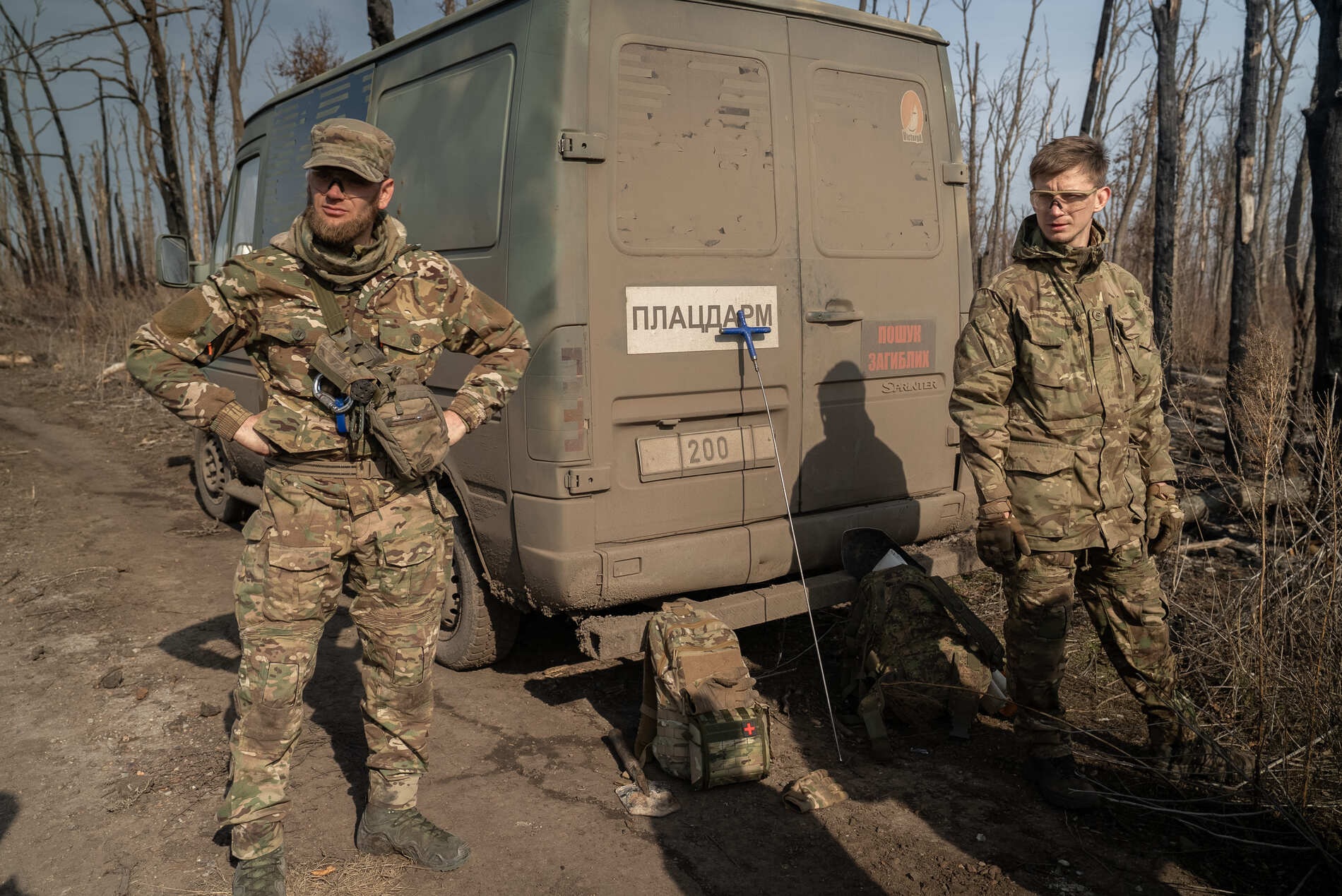
Battles once raged here. Now, only black tree trunks remained on scorched earth. Oleksii, founder of the “Platsdarm” search team, which located and exhumed the remains of the deceased, moved carefully along white-and-red ribbons that marked a safe path through the trees.
It was April 2025, in a forest on the border between the Kharkiv and Donetsk regions. We had come from Kharkiv. Oleksii arrived with a colleague, Athur, from Sloviansk, his hometown, to which the frontline kept creeping closer and where he stayed despite that. Where “Platsdarm” was based.
Oleksii kept searching for “forgotten souls” at old battle sites and along the frontline itself despite the danger. He always went first, those who knew him said. He didn’t want to endanger his team. He lost an eye to a landmine once.
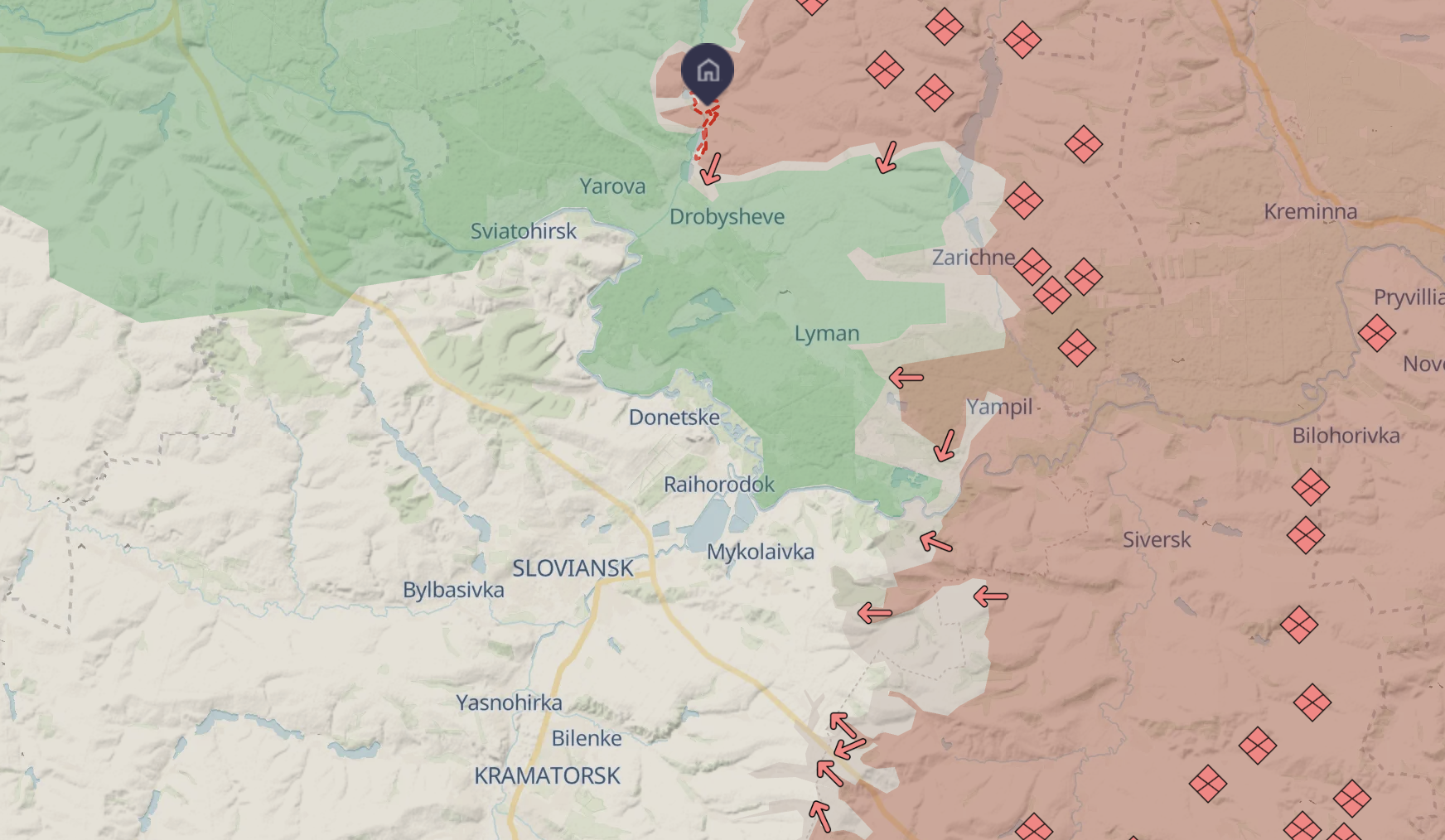
Oleksii died on August 5, 2026, near Shandryholove in the Lyman community, when the car he was riding in hit a Russian mine. This place is marked as partially occupied on the war tracking map, DeepState. Oleksii was 40.
His first farewell ceremony, scheduled for Aug. 7, in the village of Mykilske near Sloviansk, was canceled 30 minutes before it began. Ukrainian intelligence learned Russian forces had marked the site as a target after the information about the location of the ceremony was published on social media. Two journalists from our team had to get back to Kharkiv from the outskirts of the village because of the Russian glide bomb threat.
Oleksii’s family wasn’t able to say goodbye near his home.
On Aug. 8, people in Kyiv will gathered to say a final goodbye. Oleksii will be buried in the capital.
Below, read about Oleksii Yukov, a man who spent 27 years searching for the remains of fallen soldiers and a day we spent a year ago with his team.
Calling
Oleksii believed every person knows, from childhood, that they were born for a purpose. His own purpose was to find souls, retrieve them from the battlefield, and bring them home — to show the world that war is evil.
At 13, he saw a World War II battlefield for the first time, where the desecrated remains of Soviet and German soldiers lay scattered in the open. The realization that the dead deserved better set him on the path to his life’s work.
In 2013, Yukov registered the “Platsdarm” search team. By 2014, they had become the first group searching for soldiers killed in the Russian-Ukrainian war.
The name of the search team means a “bridgehead,” a staging ground for military operations from which an army can launch into battle. Months after these combat clashes, “Platsdarm” work begins from the bridgehead, too. Since the start of Russia’s full-scale invasion, the team has recovered more than 3,000 bodies.
Sisyphus’s woods
In 2025, this forest, an old witness to fighting between Soviet and German troops, wore the new scars of the Russian-Ukrainian war. Oleksii had excavated the World War II remains here as a teen. As an adult, he led a team searching for the bodies of Ukrainian and Russian soldiers.
“What has changed? Nothing. People have remained just as senseless,” Oleksii said.
He believed that Europe has to understand that war knows no borders. That Russia will attack Europe, too. “They are greedy and won’t stop unless they are stopped by force,” he said.
The Russians, he said, have forgotten that 85 years ago their grandfathers fought alongside Ukrainians against Nazi Germany. Now their descendants have come to kill Ukrainians simply for being Ukrainian аnd for money.
“We are fighting so we don’t become slaves. They are fighting to make us slaves. Until they realize that human life is priceless, there will be no chance of ending the war,” Oleksii said.
Initiates
“Platsdarm” worked like that: Oleksii and Artur went to scout the area, locating minefields to hand their locations over to bomb disposal experts. Once the area was safe, the rest of the team — seven more specialists — got to work. A process that’s far more complex than exhumation, where the location was already known.
The work demanded knowledge of military affairs and explosive ordinance disposal, first aid, and anatomy, enough to distinguish human remains from animal bones. The volunteers worked almost every day, mainly across the Donetsk and Kharkiv regions, though they had also traveled to Mykolaiv and Zaporizhzhia.
Oleksii relied solely on himself and his team, believing a small group of experienced searchers works more effectively than a large one, even given the scale of casualties.
Training takes far longer than people expect, Oleksii said. The basics can be taught quickly, but becoming a true searcher takes decades.
Omens
We kept going along the narrow path. When the scorched forest gave way to lush greenery, Oleksii made an abrupt stop. He spotted a piece of a bulletproof vest sticking out from under the fallen leaves.
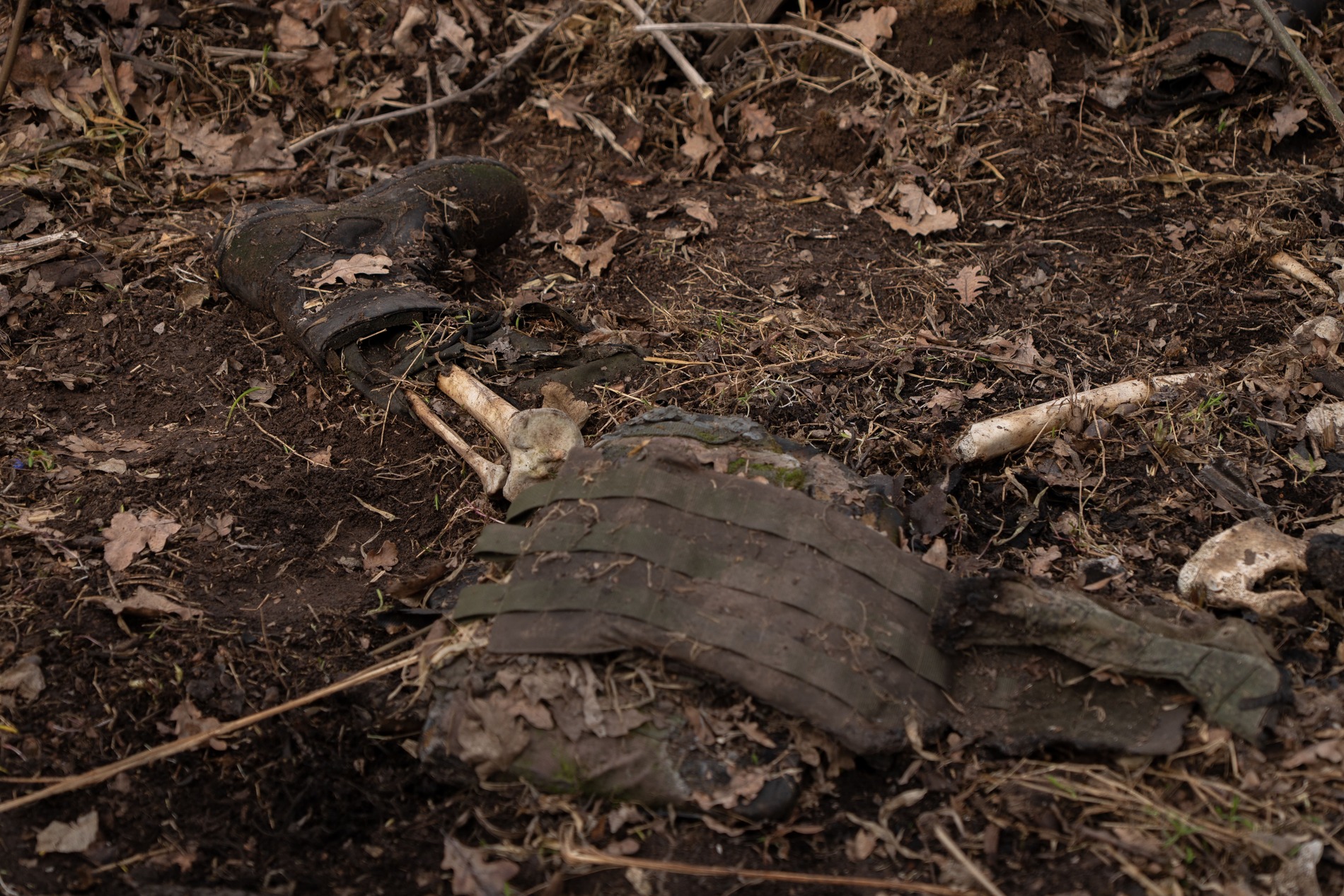
“As searchers, we believe that souls come and show us where the bodies lie, because they want to return home, just like any living person,” he said, dropping to his knees to clear the leaves away.
“There have been times when a raven led us to the fallen — it cawed, we’ve followed. After experiences like that, it’s hard not to believe in something greater.”
Volunteers had already searched this forest square by square, finding bodies of three Ukrainian soldiers and, so far, eleven Russian ones.
Oleksii, careful, cleared away more leaves. There were bones and weathered boots beneath them.
Restless shades
The speed of identification and recovery depended on the body’s condition, Oleksii said. If the body’s been torn apart by animals, it can take up to a week.
“We try to clear the site so we can see how the person died. There are a lot of charred bones here — black, blending into the ground. To see the body in its entirety, we need to clear the site thoroughly.”
Kneeling, holding an armful of dry leaves near the remains of a Russian soldier, Oleksii paused, his cap hiding his eyes. This war, he said, makes no sense from the perspective of the searchers.
“Didn’t he have a family? Didn’t he want to go home? In his final moments, as he was dying, do you really think he wanted to die?” he asked of the dead. “You die — and just like that, you’re gone. If it weren’t for us, this guy wouldn’t have had a single chance to return home.”
Oleksii believed the soul stays restless until the body returns home — until relatives can mourn. “The soul will sit there, watching us. My heart aches for every person who has died in this cursed war.”
Charon’s weather
The mist was gradually clearing. Oleksii frowned, shielded his eyes, and looked up at the sky: “This is bad — the sun’s out. We used to be happy to see it, but now, in drone warfare, sunny weather means death.”
When volunteers approach the positions, he told us, all sorts of weapons start attacking them. Working on the frontlines or in the gray zone for prolonged periods was also dangerous. That’s why evacuating the dead meant choosing the worst possible weather: fog, or better yet, rain.
“It’s very hard to drag someone through the mud in a downpour. You’re already exhausted, wearing armor, carrying backpacks and shovels — almost 40 kilograms of gear. Then there’s the body, another 80 kilograms, and the two of you are dragging it all under fire. You take cover, wait for the shooting to subside, then move again.”
Rites
After clearing the site, the volunteers set out yellow numbered tags next to the remains and ammunition to mark physical evidence.
Artur wrote the names of the nearest settlements and the body’s number on a board, then pulled an anatomical banner from his backpack: a sturdy white canvas depicting the human skeleton.
Oleksii laid out the remains they’ve found on it — the lower limbs, the pelvic bones, the spine, the charred upper limbs — and finally retrieved the burned skull from inside the helmet.
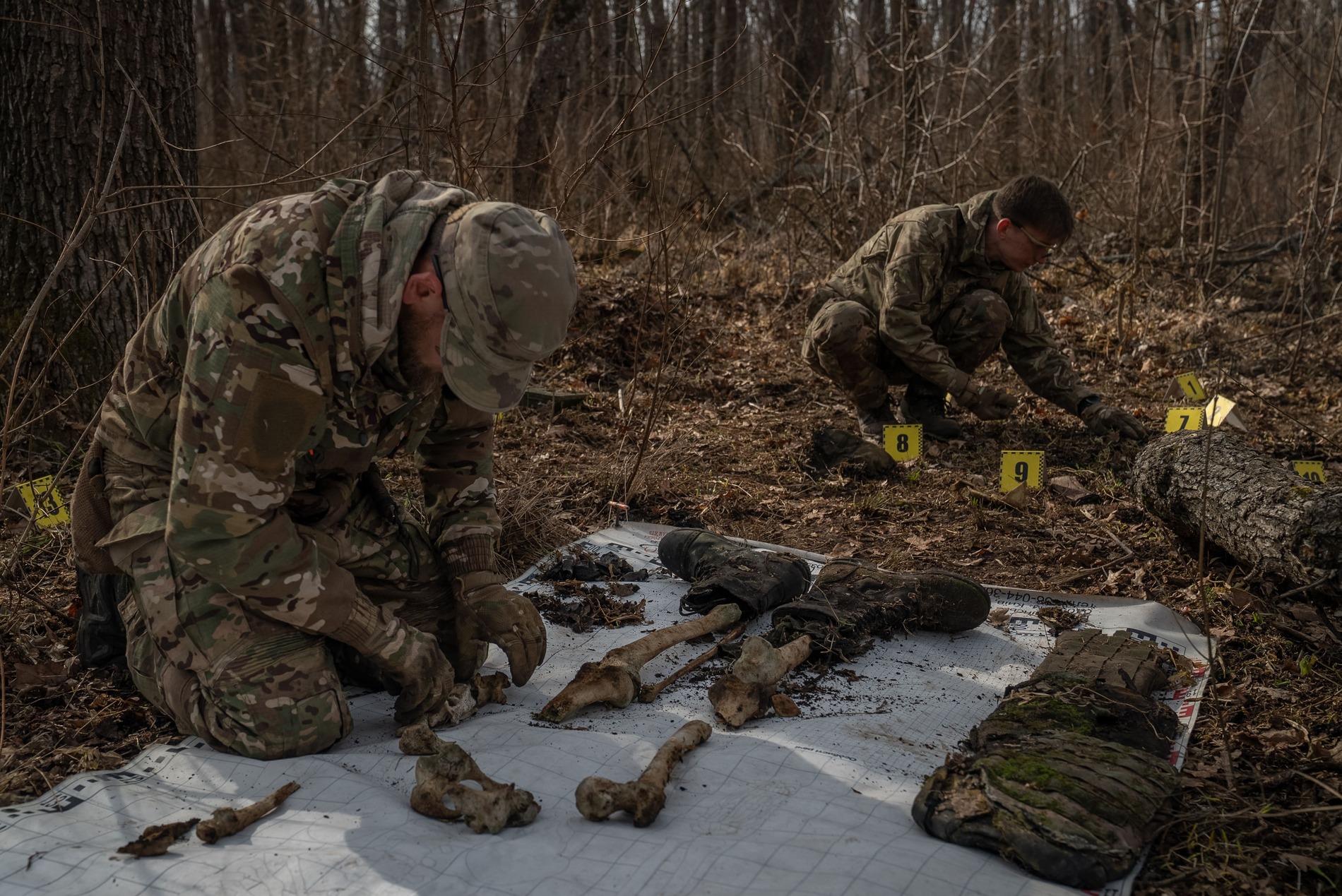
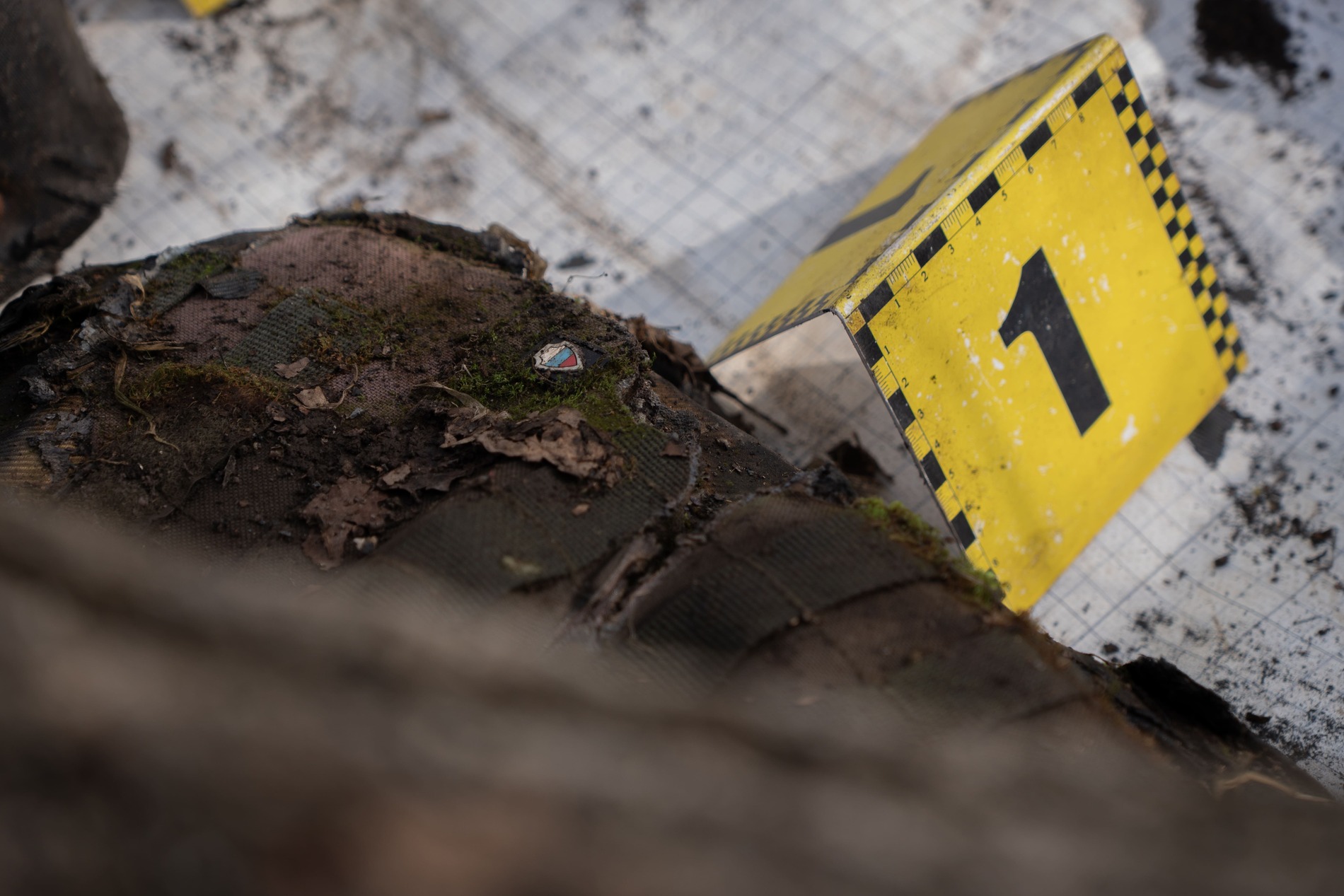
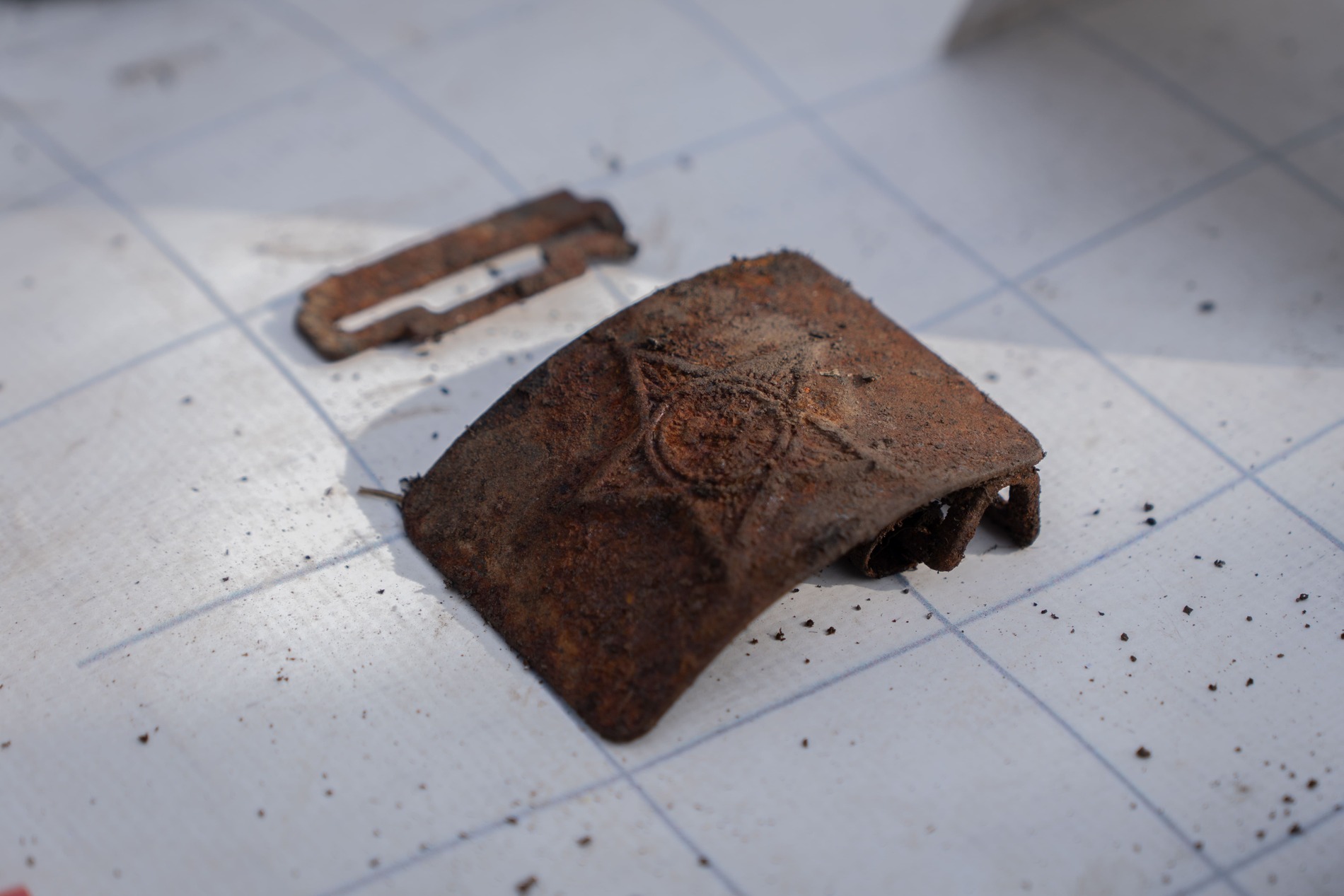
He then walked the site once more with a small metal detector, searching for the smallest pieces of evidence that might confirm the soldier’s affiliation — tags, and the like.
Fragments of equipment helped determine whether the remains belonged to a Russian soldier, a Ukrainian soldier, or a local civilian.
But clothing alone wasn’t reliable: there were cases when Ukrainian soldiers broke out of encirclement wearing Russian uniforms, and Russian sabotage groups used Ukrainian “pixel” camouflage for diversions.
Ferryman
“Are you recording?” Oleksii looked over the assembled skeleton, preparing to be filmed for the finished work.
“Yes.” Artur’s phone was set up.
Oleksii began dictating, “The body of a serviceman from the Armed Forces of the Russian Federation has been identified, indicated by his uniform and equipment…”
Volunteers photographed and filmed every finding, submitting the materials to the General Staff and the Bureau of Forensic Medical Examination, which also prepared the bodies for exchange with Russia.
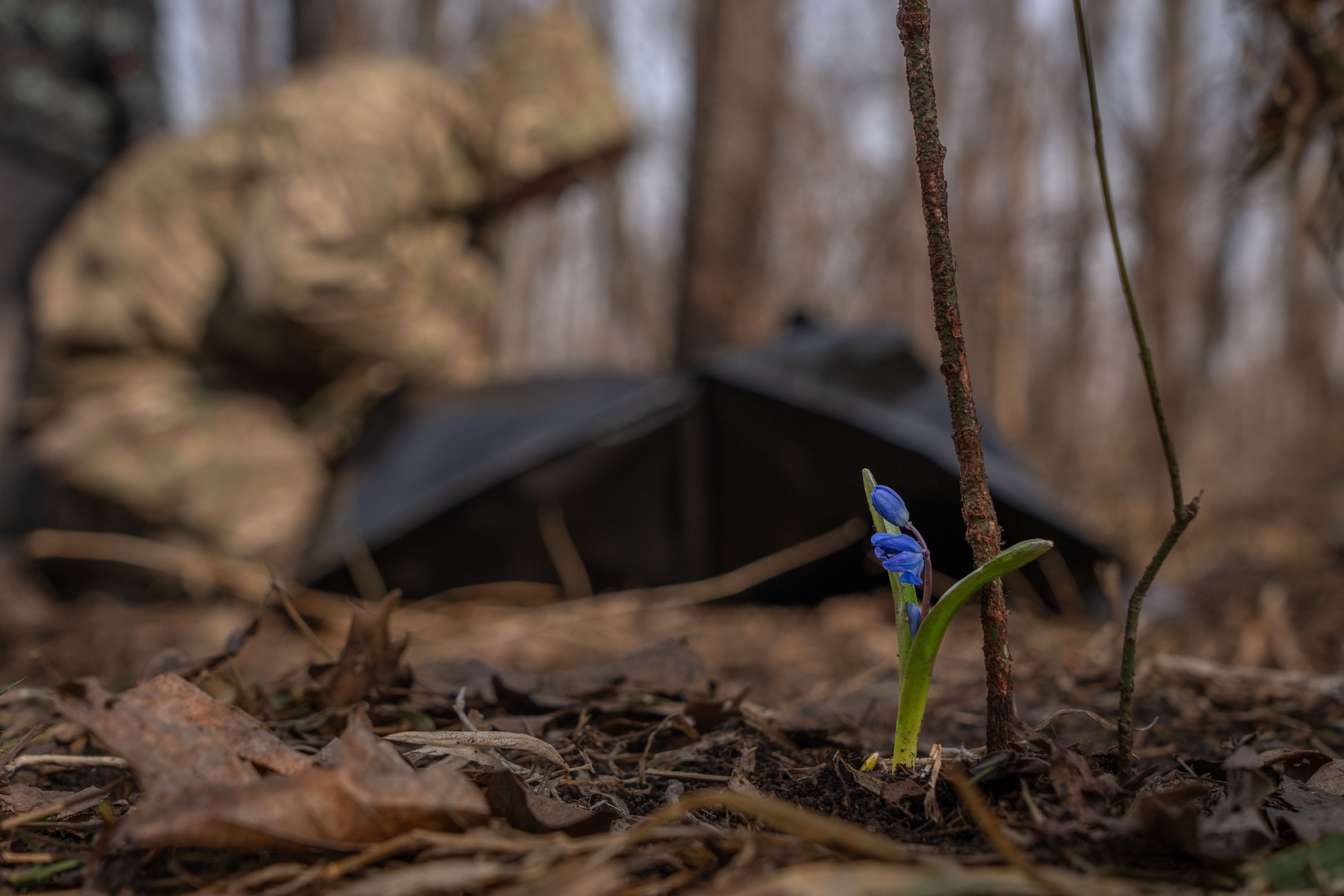
Many people don’t understand why recovering Russian soldiers’ bodies matters, Oleksii said. He explained: the work of his team, and of similar search groups, was what made it possible to bring dead Ukrainian defenders home from occupied territories.
More than a thousand bodies of Russian soldiers found by “Platsdarm” volunteers have been sent back to Russia.
Vow
“We don’t rescue the dead, we rescue the living,” Yukov said in the RFE/RL’s documentary Give Me Back My Name. “First and foremost, it’s about the families who are waiting.”
When parents call to thank him for bringing their child home, Oleksii said, he realizes how much it matters. Without the body, the puzzle of life never comes together for the ones left behind. They need a place to bury their dead, to say the words they didn’t have time to say.
In an interview with journalist Ramina Eskhakzai, Yukov made a promise to Ukrainian soldiers: if they die, he will find them.
“Stay alive, and come home. And if you happen to die, we’ll take your souls and bring them home. We’ll bring them back 100%. And even if we die — I’ll know what we died for. For each and every one of you. Just as you’ve died for each and every one of us.”
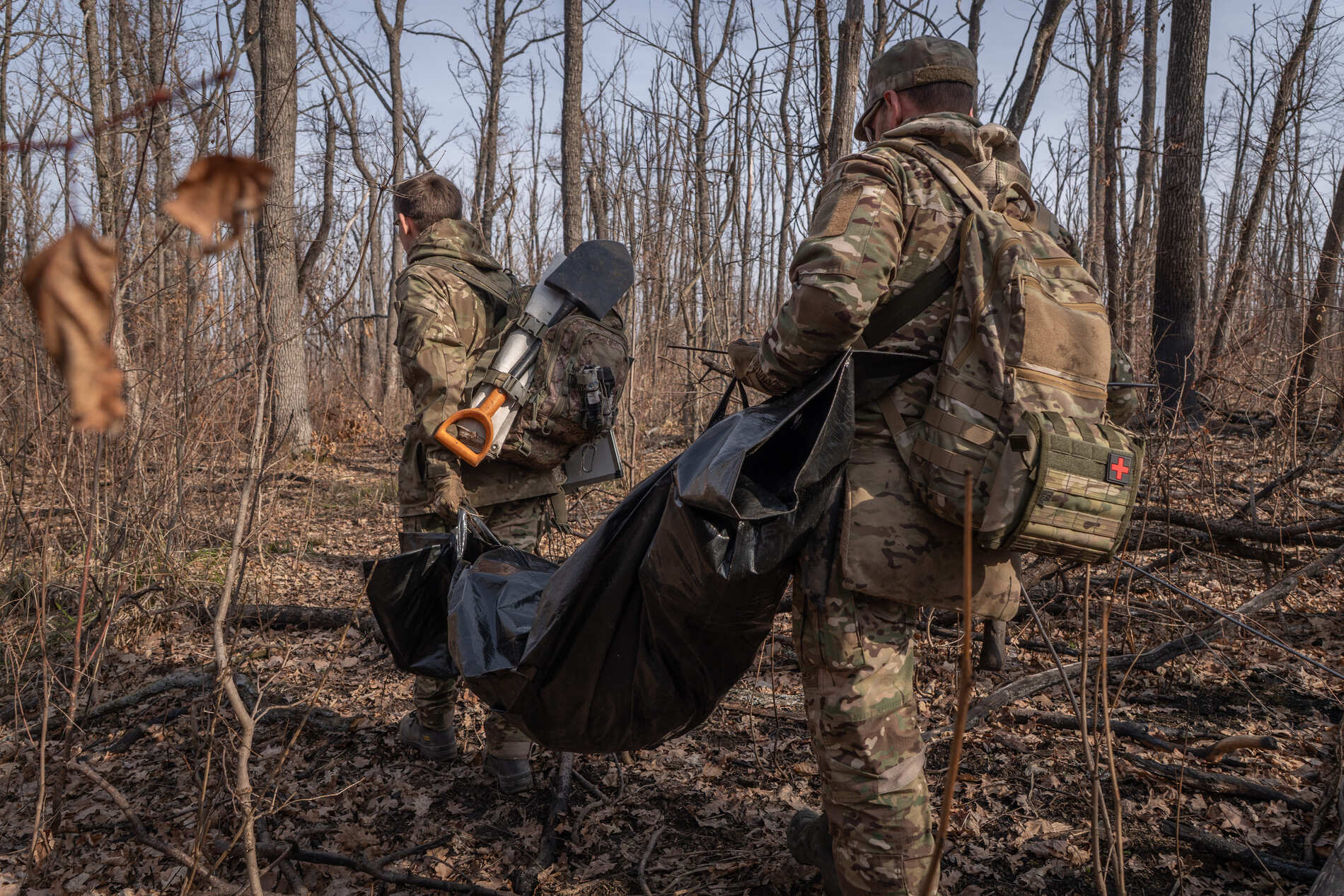
“What a human one has to be, that entire Ukraine mourned them. Now, the dead he won’t (save) are orphaned,” wrote Halyna Hladush, one of the hundreds of people who knew Oleksii’s work.
Colleagues who have lost a teacher and leader say that Oleksii did not die in vain. They will keep searching.
Hi. I am Polina Kulish. I worked on the “Platsdarm” report back in April, 2025. Oleksii remains the person who has had the greatest spiritual impact on me out of everyone I’ve met during this war — you can watch a video featuring him by following the link. Not only has “Platsdarm” lost its founder, but Ukraine has lost one of its most experienced exhumers, a humanist and a patriot. Our condolences to Oleksii’s family and the “Platsdarm” unit. We mourn alongside you.


Subscribe to news from Kharkiv, Ukraine
Most important stories from the frontline region