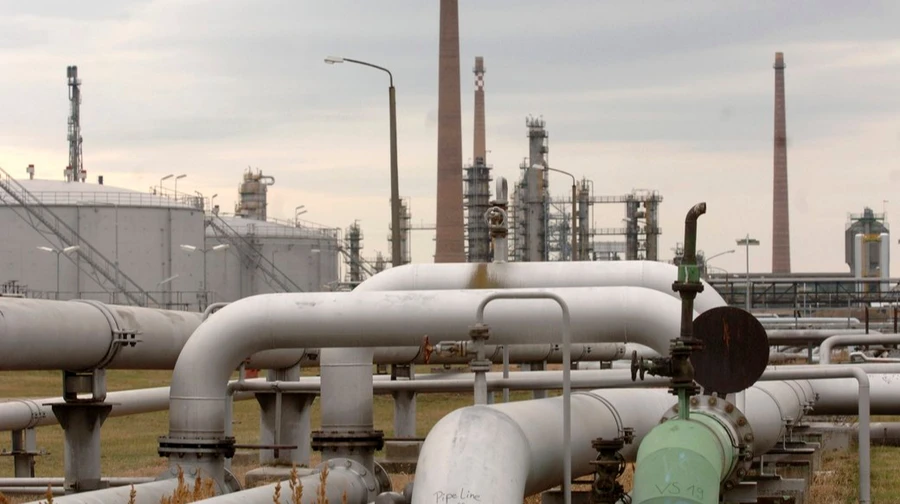
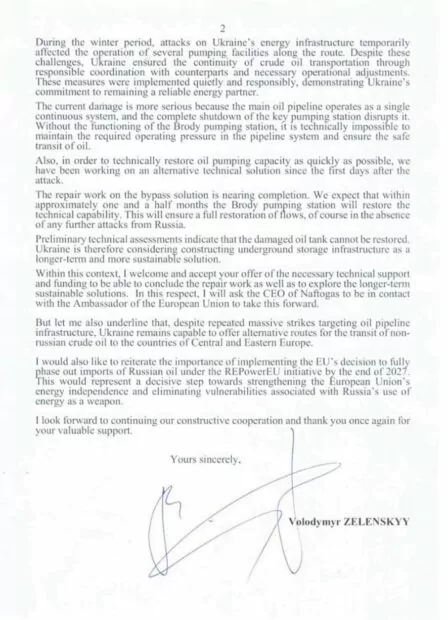
UKRAINE, Mar. 17 — Volodymyr Zelenskyy, the President of Ukraine, in his letter to Ursula von der Leyen, the President of the European Commission, said that Ukraine expects to restore oil transit through the Druzhba pipeline within one and a half months if Russia does not attack the pipeline again.
On Mar. 16, von der Leyen with Antonio Costa, the President of the European Council, sent a letter to President Zelenskyy proposing to provide the technical and financial support in restoring transit of the Russian oil to Hungary and Slovakia.
European officials added that Hungary is now “not in a position” to vote either for the €90 billion loan for Ukraine or for the 20th package of economic sanctions against Russia. They also said that because of the current high volatility of energy markets oil transit through Ukrainian territory becomes of greater importance to preserve market stability. The price of oil increased dramatically to $102.98 as of Mar. 17 from $68.81 last month after the US started a war with Iran.
In his response, Volodymer Zelenskyy said that he accepted European officials’ offer so Ukraine can complete the repair of the Brody pumping station (the part of the Druzhba pipeline) as soon as possible.
Zelenskyy also added that despite constant Russian air attacks Ukraine can offer the alternative routes of the Russian oil to Slovakia and Hungary.
Still, Ukraine’s president emphasizes the importance of implementing the EU’s decision to withdraw from the Russian oil import by the end of 2027.
“This would represent a decisive step towards strengthening the European Union’s energy independence and eliminating vulnerabilities associated with Russia’s use of energy as a weapon,” Zelenskyy said.
Disruption of Druzhba pipeline
The oil delivery through the Druzhba pipeline has been halted since Jan. 27. Back then, Kyiv reported on the Russian attack on the pumping facilities in western Ukraine (Brody pumping station, according to Zelenskyy’s letter). Then, on Mar. 3, Denys Shmyhal, the Minister of Energy of Ukraine, reiterated that Russia severely damaged the Ukrainian branch of the Druzhba pipeline.
On Feb. 21, Viktor Orban, Hungarian Prime Minister, threatened to suspend power supply from Hungary to Ukraine if oil transition isn’t restored.
On Feb. 23, Slovakia’s Prime Minister Robert Fico backed Orban, saying that Slovakia will stop emergency power supplies to Ukraine until Russian oil deliveries through the Druzhba pipeline are restored.
On Mar. 4, SEPS, Slovakia’s state-owned electricity transmission operator, announced the termination of its contract with Ukrenergo, Ukraine’s national power company, for emergency power supplies.
According to the sources of the Financial Times, Katarína Mathernová, EU Ambassador to Ukraine, asked Ukraine for permission to inspect the Druzhba pipeline, but her request was denied.
However, a senior Ukrainian official close to Zelenskyy told FT that technical experts from Naftogaz, Ukraine’s state-owned oil and gas company, have provided their European counterparts with evidence showing that Russia seriously damaged the pipeline.
Serhii Koretskyi, Naftogaz CEO, told the Financial Times that a Russian strike set fire to a tank holding 75,000 cubic metres of oil and it took 10 days to put it out.
“Numerous pieces of equipment, power cables, transformers and a leak detection system responsible for pipeline sealing were damaged,” he said.
Ukraine-Hungary relationship
Hungarian Prime Minister Viktor Orbán’s blockade of a €90 billion loan for Ukraine, along with threats to suspend power supplies after reported Russian attack on Druzhba pipeline, have strained relations between the two countries.
On Mar. 5, Zelenskyy, at a briefing on results of the government work, said that he would give Orban’s address to the Armed Forces of Ukraine if Hungary doesn’t veto the loan to Ukraine.
“Let them (Ukrainian military) call him (Orban) and talk to him in their own language,” Zelenskyy said.
On the same day, Zoltán Kovács, Hungarian government spokesman, said that Budapest described Zelenskyy’s statement as an open threat.
On Mar. 6, the European Commission condemned Zelenskyy’s threats to Orban.
“There must not be threats against EU member states,” said Olaf Gill.
On the night of Mar. 6, the National Bank of Ukraine (NBU) reported that two of Ukrainian state-owned Oshchadbank’s cars were detained by Hungarian law enforcement. There were seven bank workers in the cars, and all of them lost cellular connection.
Andrii Sybiha, Minister of Foreign Affairs of Ukraine, called the Hungarian detention of seven Ukrainian bank workers on suspicion of money laundering in Budapest a part of “Hungary’s blackmail and electoral campaign” in preparation for the Apr. 12 parliamentary election.
Read more
- Russian “small groups” of infantry attempt to advance toward Kupiansk-Vyzlovyi, Ukrainian military says
⚡ The fifth year of the Russian full-scale invasion started, so it’s been four years since most of us here at our Kharkiv-based newsroom became war reporters. Please consider supporting our journalism via a one-time donation — or join our community.

Subscribe to news from Kharkiv, Ukraine
Most important stories from the frontline region