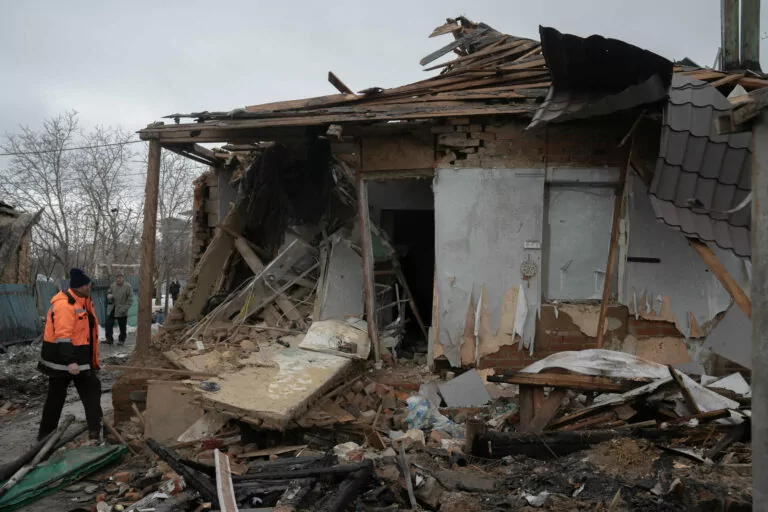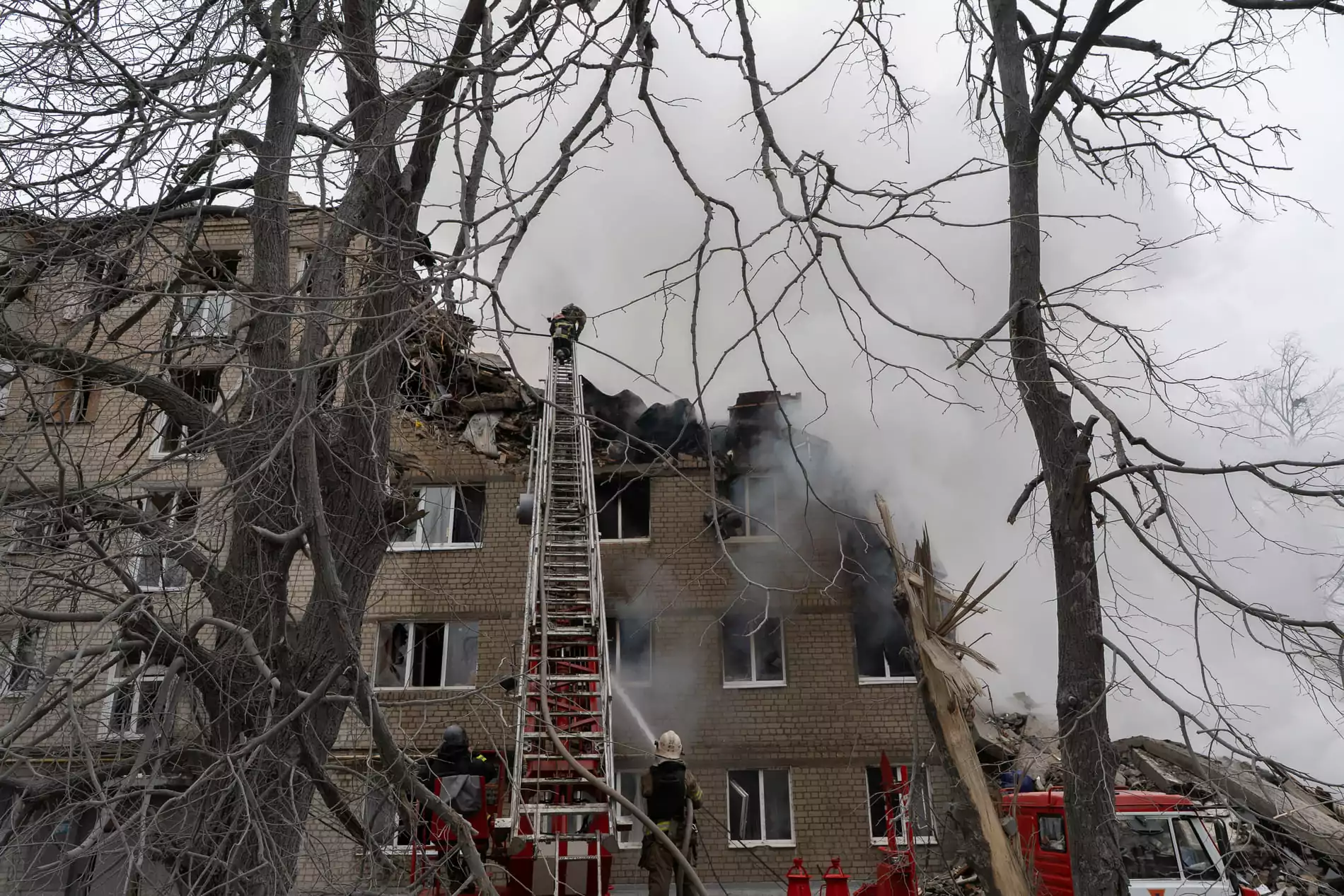
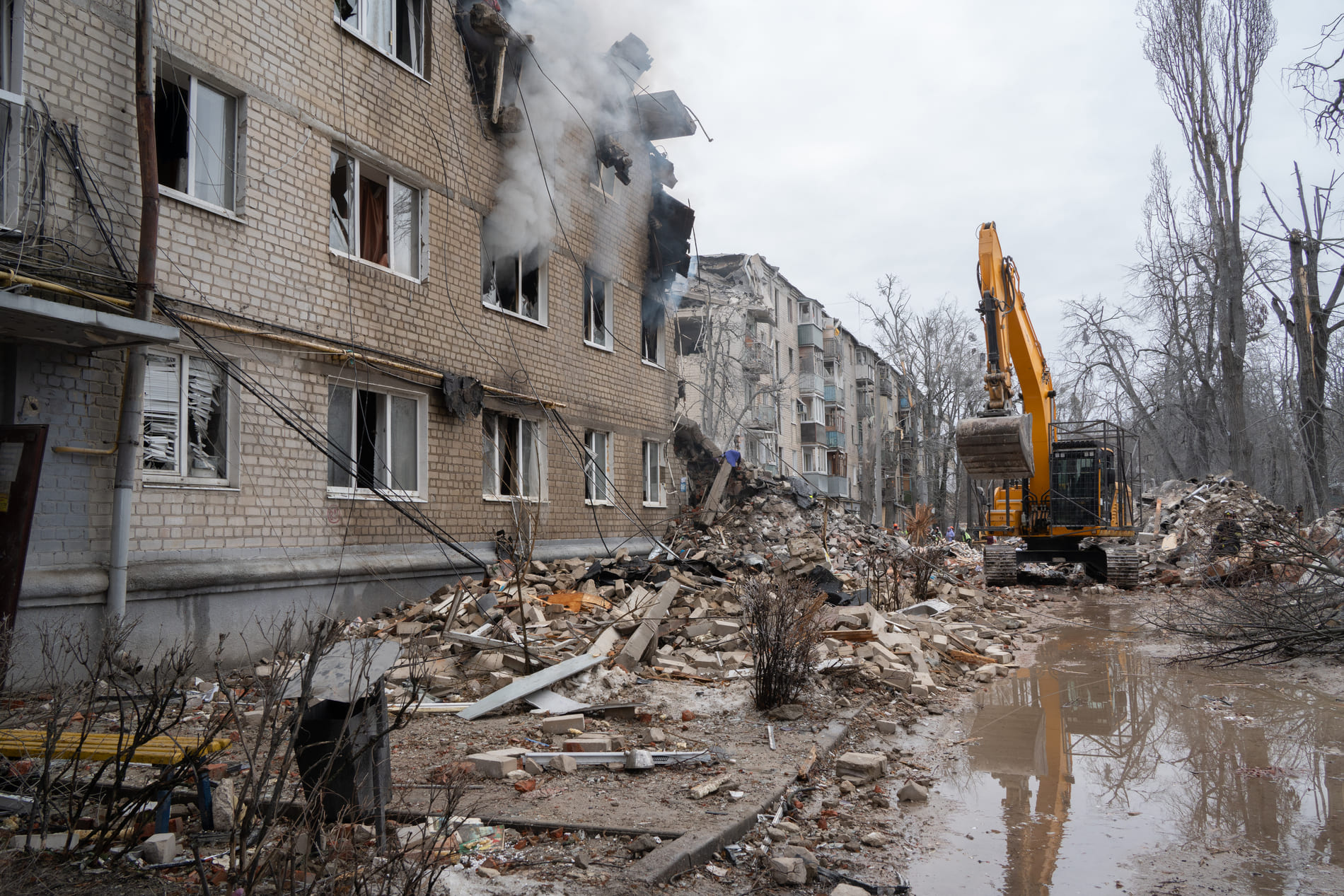
UKRAINE, KHARKIV, Mar. 7-8 — Emergency workers started their first shift at about 2:00 a.m. on Saturday. A Russian missile strike caused a huge fire, destroyed a big part of a five-storey building and buried, according to official data, at least 14 people underneath the rubble and flames.
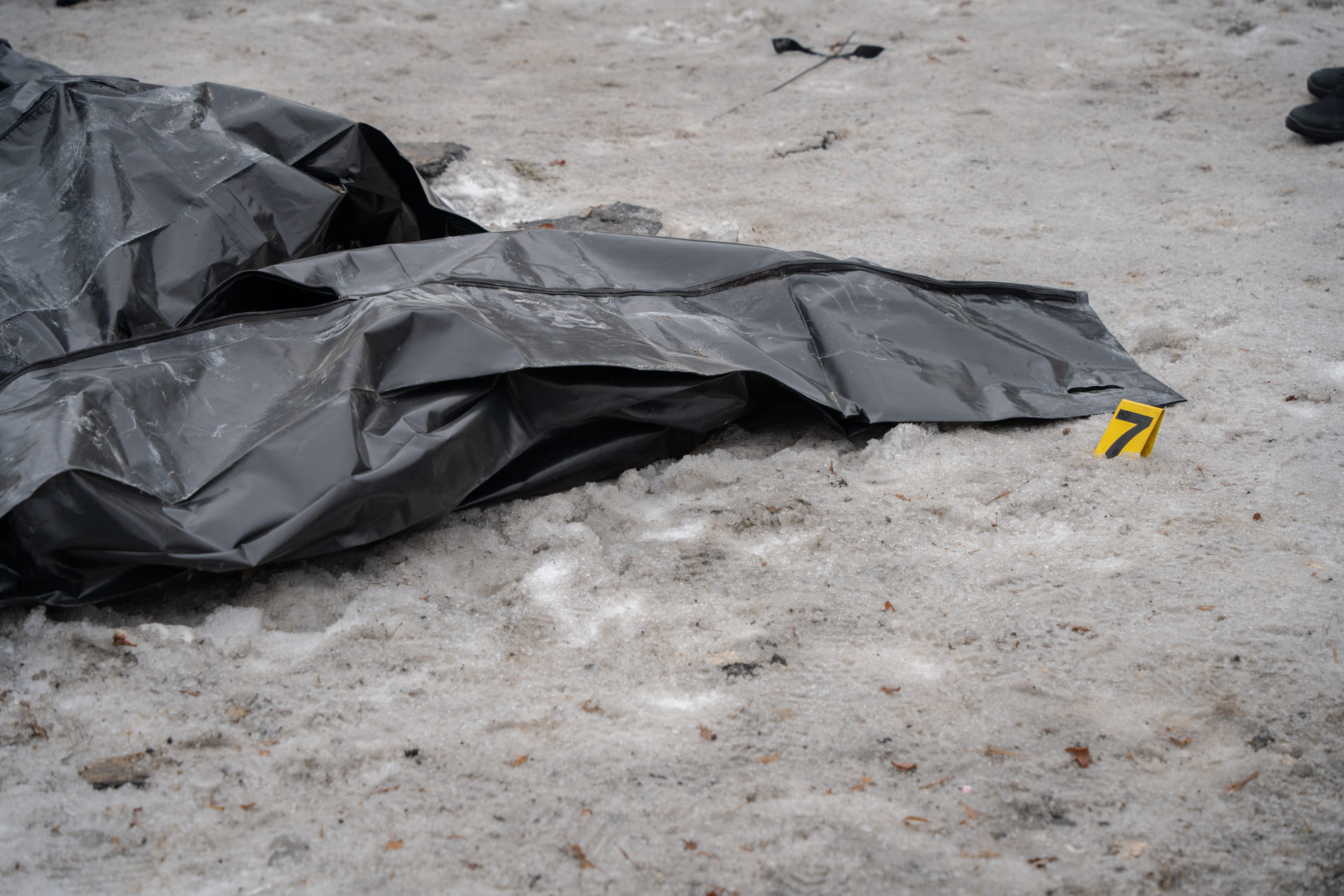
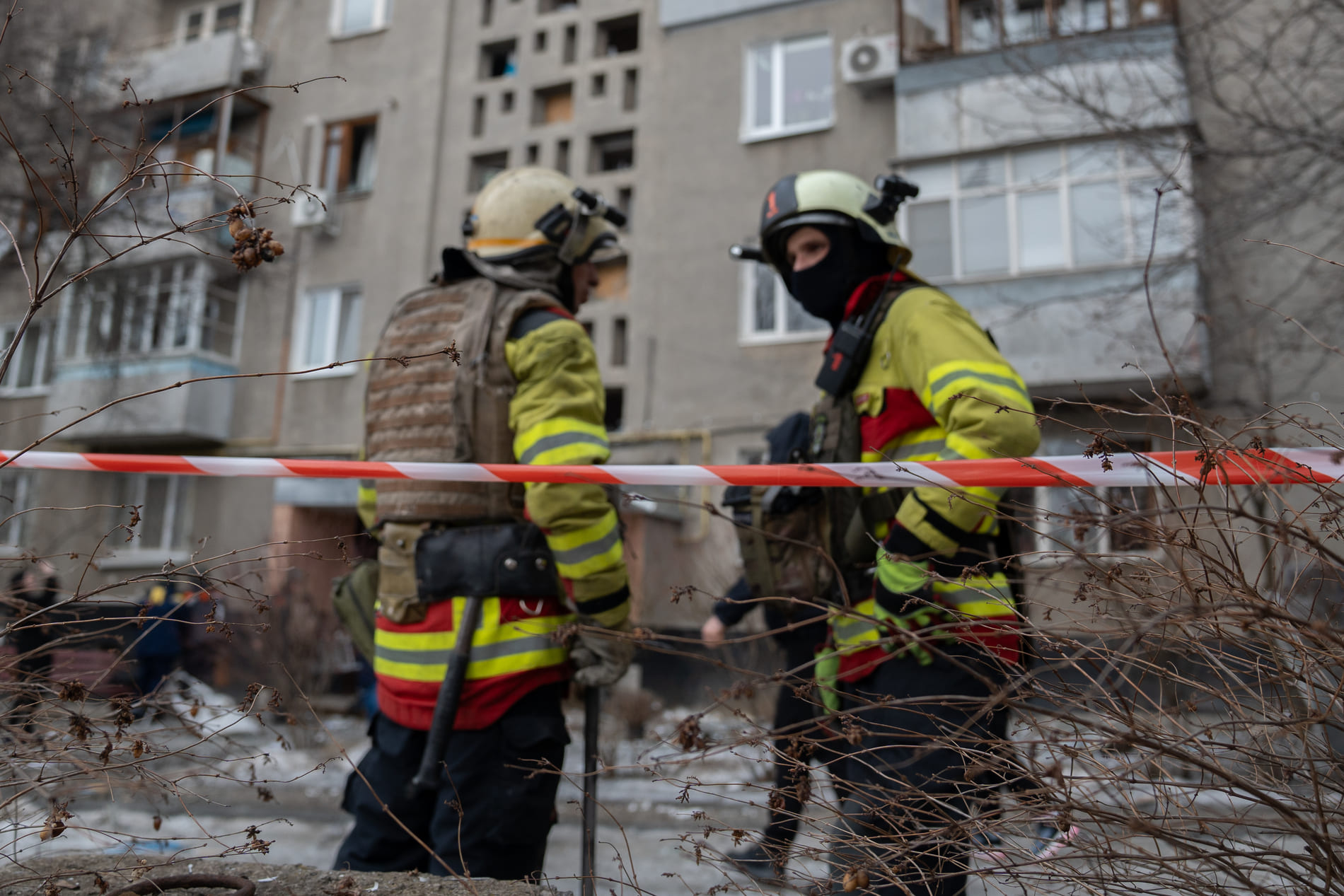
When we arrived in the neighbourhood in the morning, seven bodies had already been recovered, and the search and rescue teams worked amidst the remains of people’s apartments, surrounded by the rising smoke.
A man and a woman walk towards this apartment building’s yard, both pale. Mother and a son. I don’t manage to get their names. The son speaks for them both. “We don’t live here. Mother’s friend does,” he says. Their friend’s apartment is destroyed, and she doesn’t pick up her phone.
Hours later, I see the man looking inside one of the body bags, a police worker standing beside, both of their faces blank, giving away nothing. He disappeared right after. I didn’t manage to talk to him.
Pieces
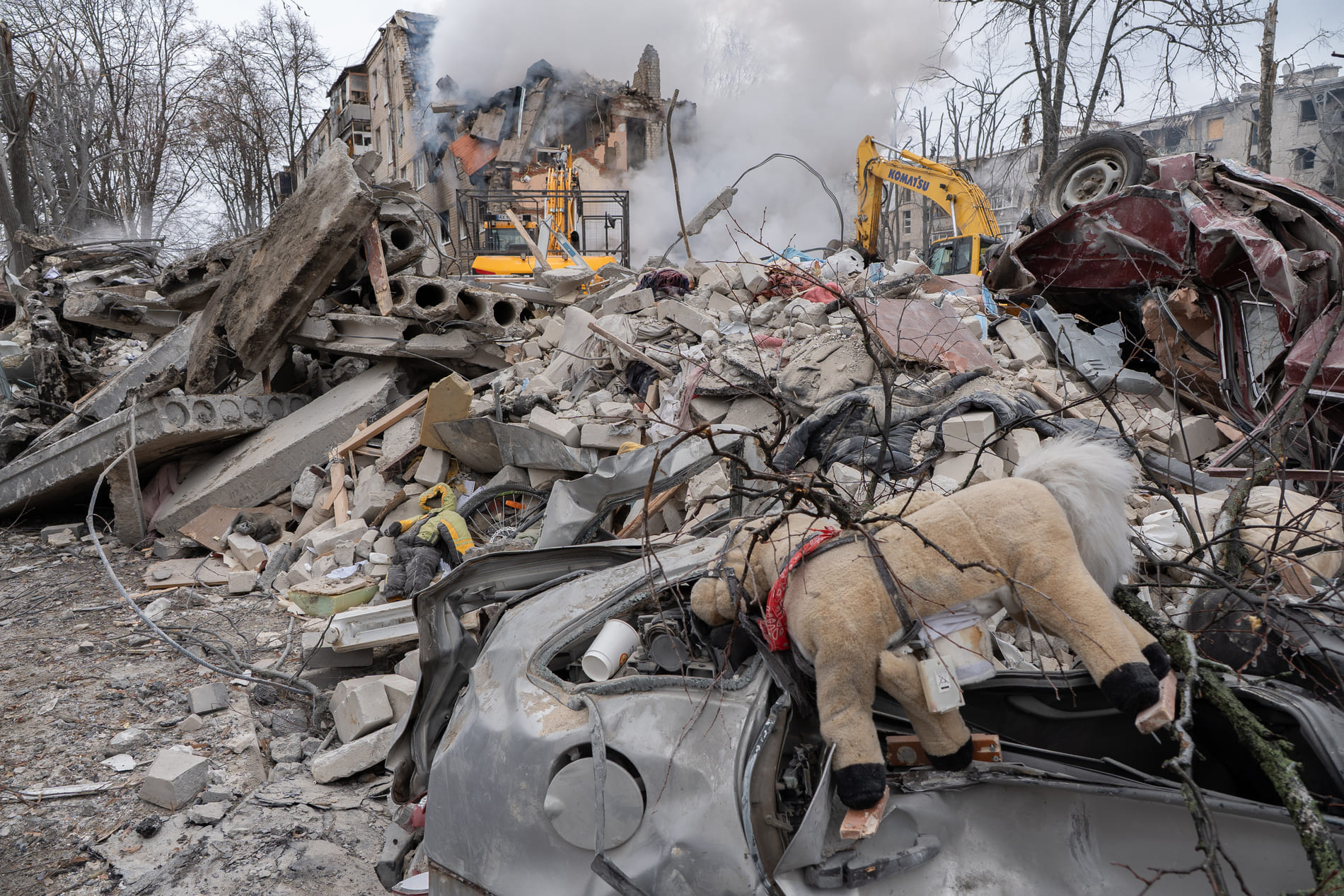
Anna doesn’t want to be filmed. She points right to where her flat should be, but isn’t, when I ask where she lived. She steps around the debris, kitchen towels and children’s toys and other things that made up her life. Looks for photos from her flat.
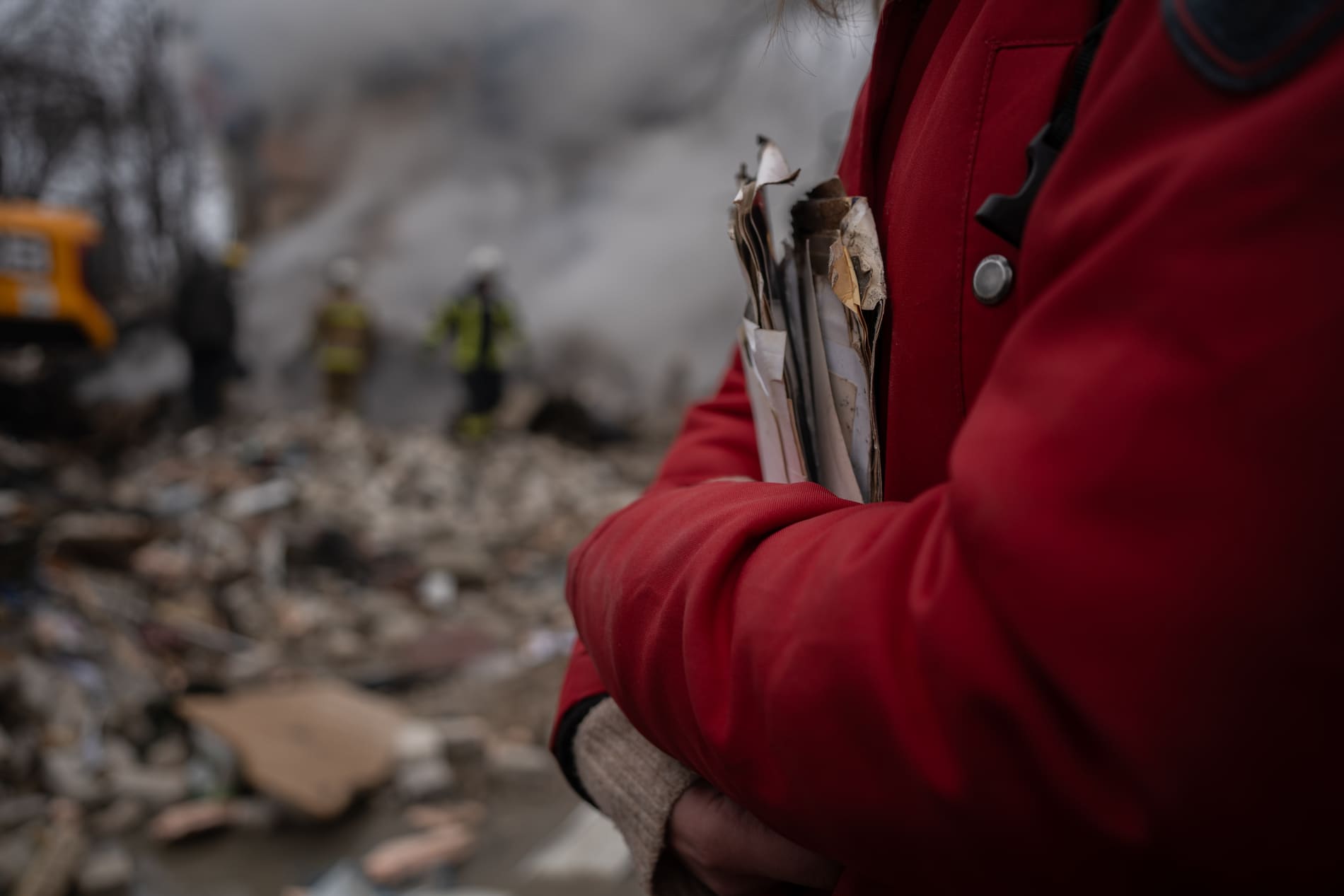
Anna has already found a pack of them. Some of them are darkened with soot from the fire, some wet — she holds them to her chest tightly. These are my grandparents’, Anna shares, and shows me black-and-white photos. Goes on, here’s my brother and I. Those are in color.
“On the night of the attack, my mom went to her brother’s, and my father was with me and my daughter on the outskirts of the city,” Anna says. “It’s lucky that we didn’t sleep here. (All that I have left) is documents for me and my child in my backpack. Nothing else.”
Anna allows me to take a photo of her hands. She says she’s not sure anything will be alright after this attack. As she searches for more of her family photos, she sometimes stops — freezes — to look at the way her apartment building burns.
Testing ground
A disgruntled man from the neighbouring apartment building shouts, refusing to talk, “what else is there to comment, except for that they’re fuckers?”
Kateryna, a dentist’s assistant, clears up her office on the first floor of the building Russia hit. She lives nearby, so was herself a witness to the thundering explosions on the night of Mar. 7.
“A lot of buildings were damaged, a lot of people suffered. And it scares me that the fire still spreads,” she says.
For hours, firefighters pour water onto the rubble, but the smoke still reaches the sky, stubborn. The World Central Kitchen’s volunteers feed people and give them water. A tent where emergency workers can warm up and rest is set up near the impact site.
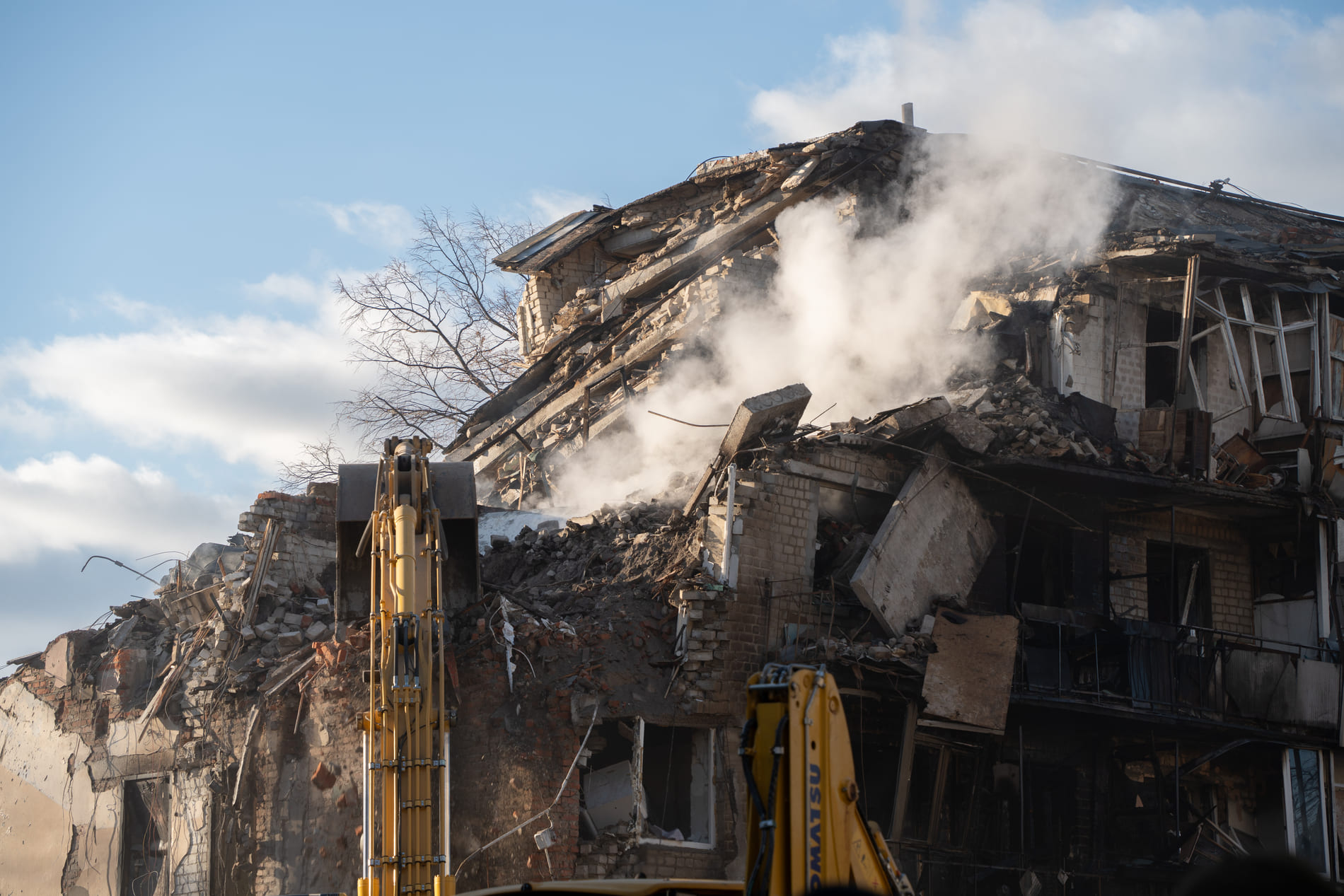
“Judging by the blast wave, it was something really serious. Ballistics, that’s the main thing. It was a powerful strike,” Oleh Syniehubov, governor of Kharkiv oblast says as I ask about the type of weaponry Russia used.
The local prosecutor’s office later reports that, according to preliminary findings, it was Russia’s new subsonic missile, Izdelie-30 (Изделие-30 in Russian or “Product-30” or “device” in English — ed). Izdelie carries a warhead with a weight up to 800 kg (1763 lb) that can be launched from the jet from over 1,500 km (932 miles).
Ukrainian intelligence released a 3D model of this new subsonic missile just a week ago. Manufactured in Russia, it carries foreign components from the USA, China, Switzerland, Netherlands, and Belarus. This is not the first time Russia tests its new weaponry on Kharkiv and Kharkiv region, the latter adjacent to the state border and encroached on by Russian troops from different sides.
Children
On Saturday, Mayor Terekhov said that search and rescue operations may continue for up to two days. As of 4:07 p.m. Sunday, there’s information about at least 10 bodies recovered from under the rubble, two of which belonged to children.
Hordii, 9, was a member of a hockey team in Bila Tserkva, one of the cities in central Ukraine. He was killed alongside his mother, a primary school teacher. His team recalls the childhood joy with which he came to every class, calling him sincere and kind.
Lisa, 13, trained as a naturalist in Kharkiv zoo. Russia killed her along with her mother and grandmother. Her teacher Euhen Kiosia wrote on his Facebook, “It seems that you understand that life in Kharkiv and many other cities is a deadly lottery of sorts. And, sooner or later, the time will come for many of your close people and for you, too. That’s the reality of war. But it doesn’t lessen the pain you feel every time.”
Maria Malevska, Ukrainian journalist, wrote on her Instagram that Lisa’s father is a soldier who serves on the Kupiansk axis. “He was left with nothing: has neither family, nor home.”
Rescuers also found body fragments. It is currently unknown how many people they belong to, but Kharkiv mayor Ihor Terekhov reported on at least one.
Saved
Apart from killing people, the Russian attack injured at least 16 people (according to the latest information) and damaged over 20 buildings — two years ago, Moscow already hit one of those.
One of the damaged buildings is the school — its windows blown out, books and papers scattered on the classroom floors. No one studies here — children in Kharkiv learn remotely or in the underground schools. The only ones who came to work on-site are the school’s administration.
Karina, the school’s deputy director, says she came to clean up here right after the attack. There’s a “point of invincibility” open here, a place where locals come to charge their phones and drink hot drinks when Russian attacks cut their electricity or heating.
“That’s the first thing we’ve cleaned,” Karina says.
Another building that was damaged is Natalia’s: the door is still stuck after the blast wave messed up its hinges. Natalia struggles to open it as her dog, Tibby, circles her legs.
She was in the bathroom when the missile hit. There’s a hole in the wall to the bathroom, albeit small.
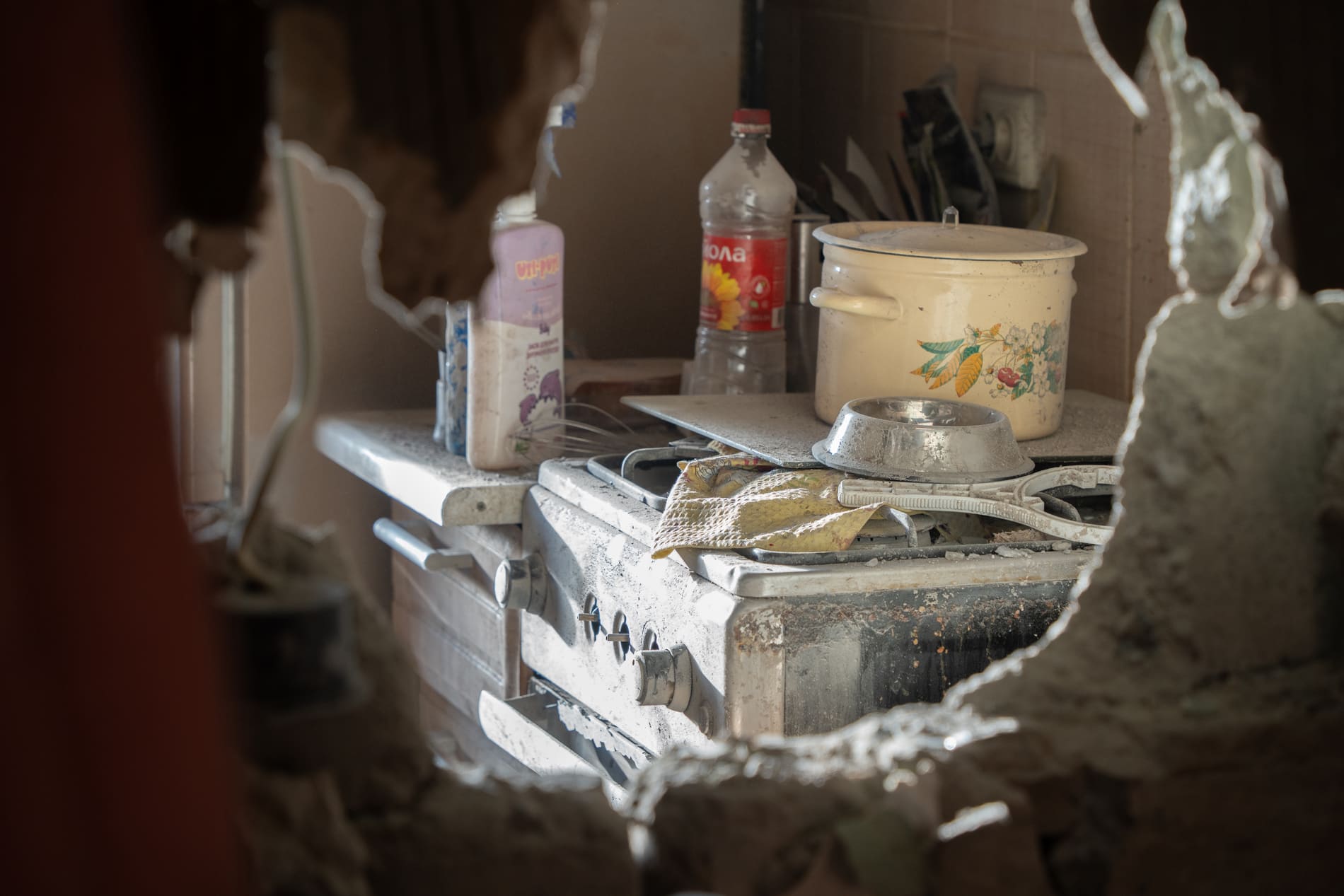
“It seems that someone is watching over me,” Nataliia says – there is a hole in the wall of her bathroom, albeit small, but she wasn’t injured. Things would be worse if she’d be in bed, she says. The blast wave threw the bricks right at where her head would be as she slept.
Nataliia’s mother, who’s 94 and has mobility issues, her two cats, and Tibby were also home when the Russian missile hit. No injuries, too — Nataliia responds to my colleague Daria’s question — but emergency workers convinced Nataliia to get her mother to the hospital.
Here, in Nataliia’s flat, municipal workers have already boarded up the windows and cleared most of the dangerous debris.
She plans to stay there — she doesn’t know who’ll host her and her three pets. “I will clean up. Do something. Live somehow,” Nataliia says. “Though all this means I won’t go mountain skiing in Bukovel (the largest ski resort in Eastern Europe, located in Ukraine). I’m gonna skip my 40th time there.”
Day two
When I come to the impact the next morning, the fire is finally out. The smoke in the air is replaced by dust. The water firefighters used, mixed with icy slush, melted during the sunny morning, softened the ground, and made it sticky. I notice small greenery peaking out from where the large wheel tracks are imprinted into the soil.
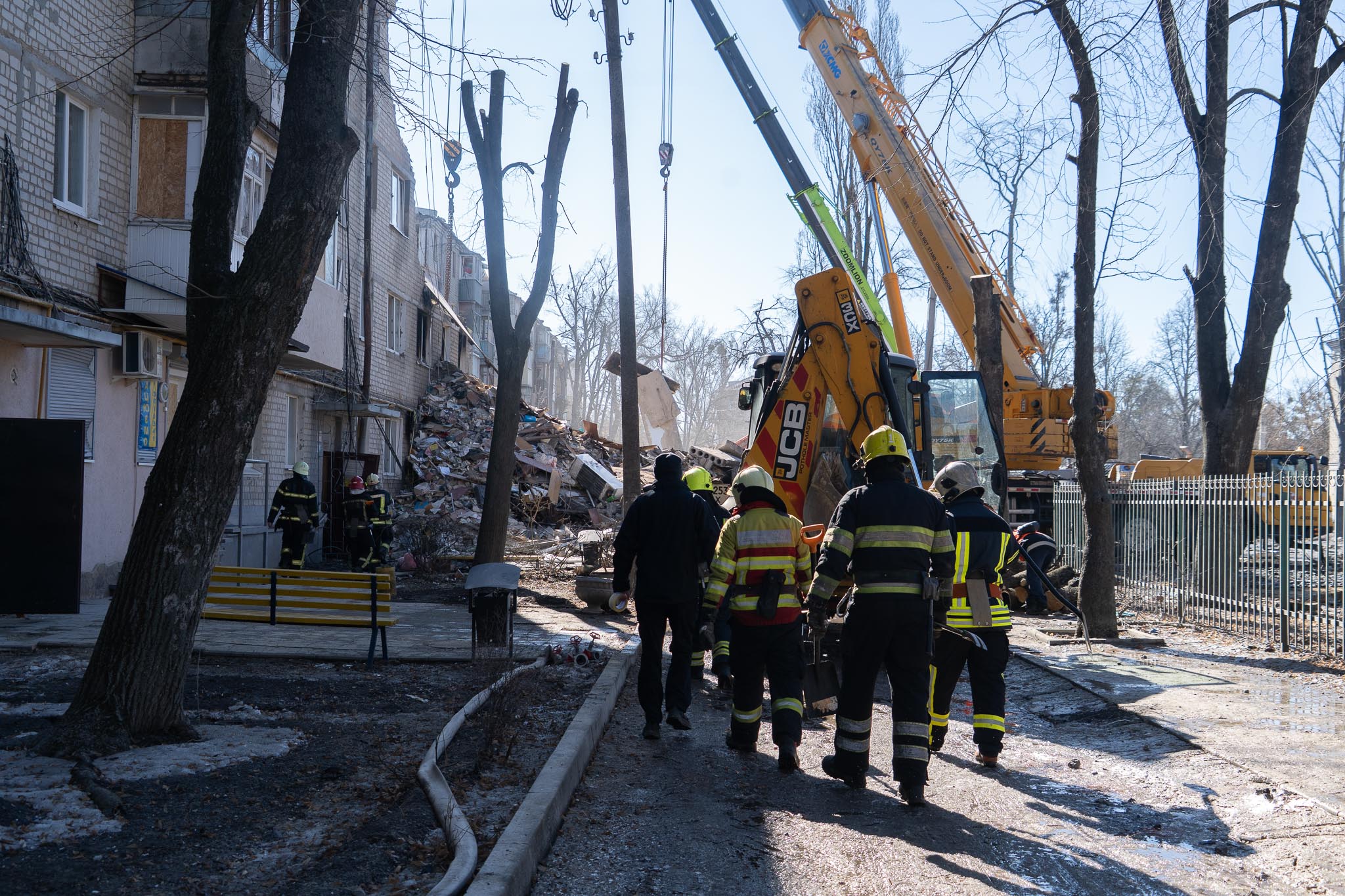
Emergency workers throw the debris from the top of the damaged buildings. The one closest to the epicenter of the Russian attack looks as if its corner flat has been cut off by a giant sword.
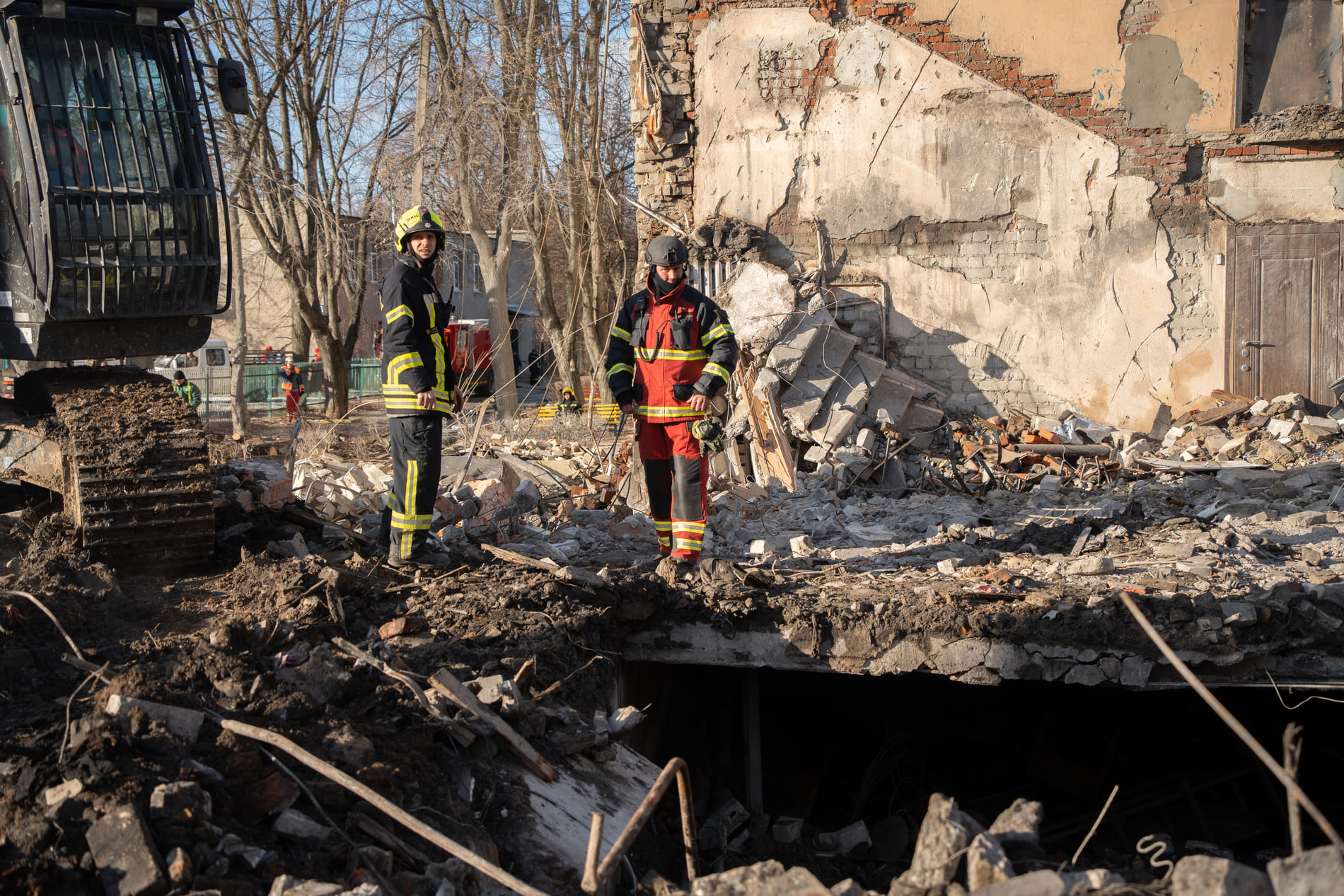
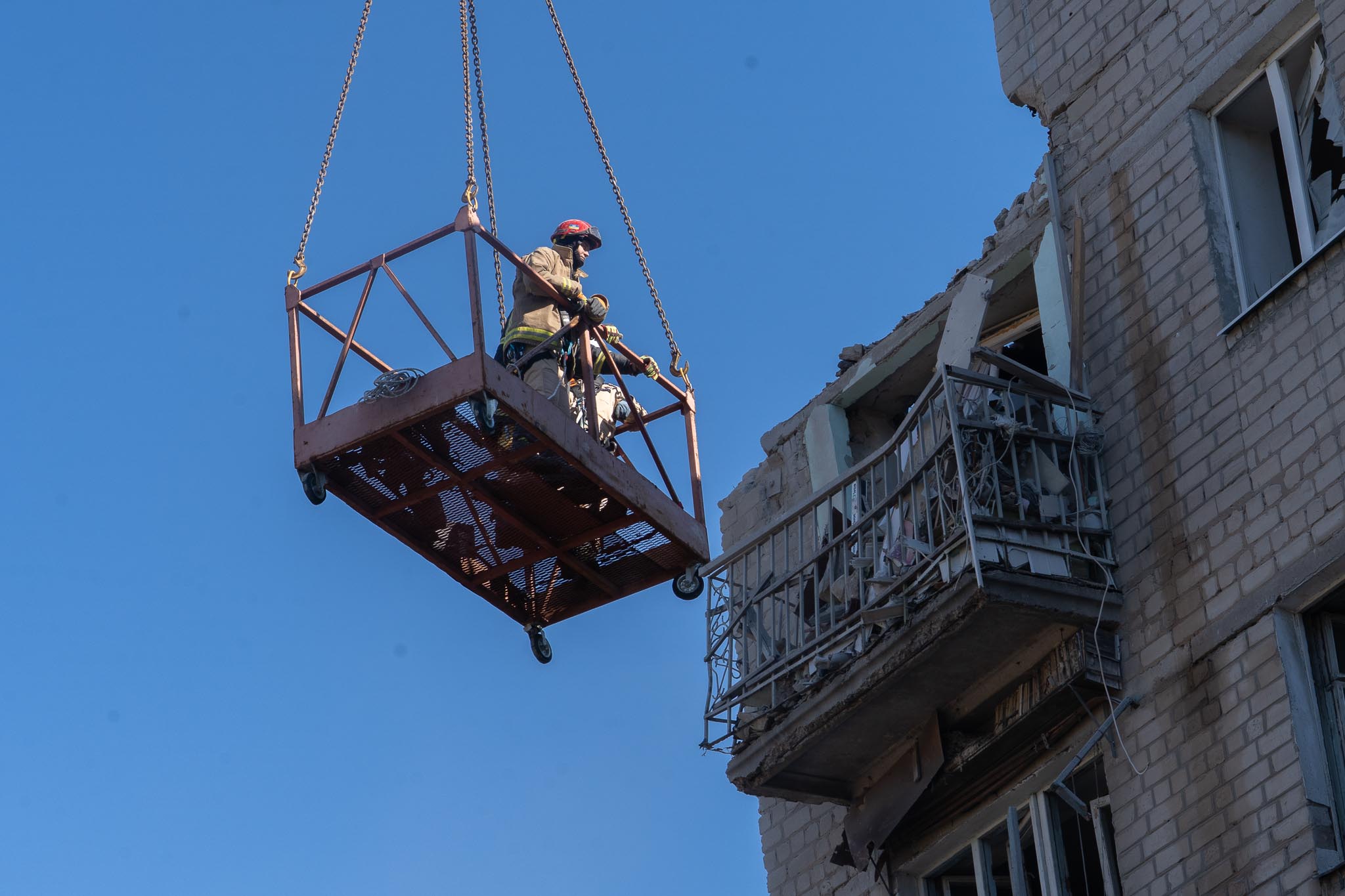
Two yellow construction cranes pull large slabs of concrete, previously walls and floors and ceilings, down into the pile of stone below, allowing search-and-rescue operation — though, at this point, mostly search — to continue without risk. Three of them, lifted by one of the cranes to reach an inaccessible part of the building, grab for the unsteady surface when the platform moves close enough towards it. After sticking a landing, they disperse inside the mostly destroyed flats.
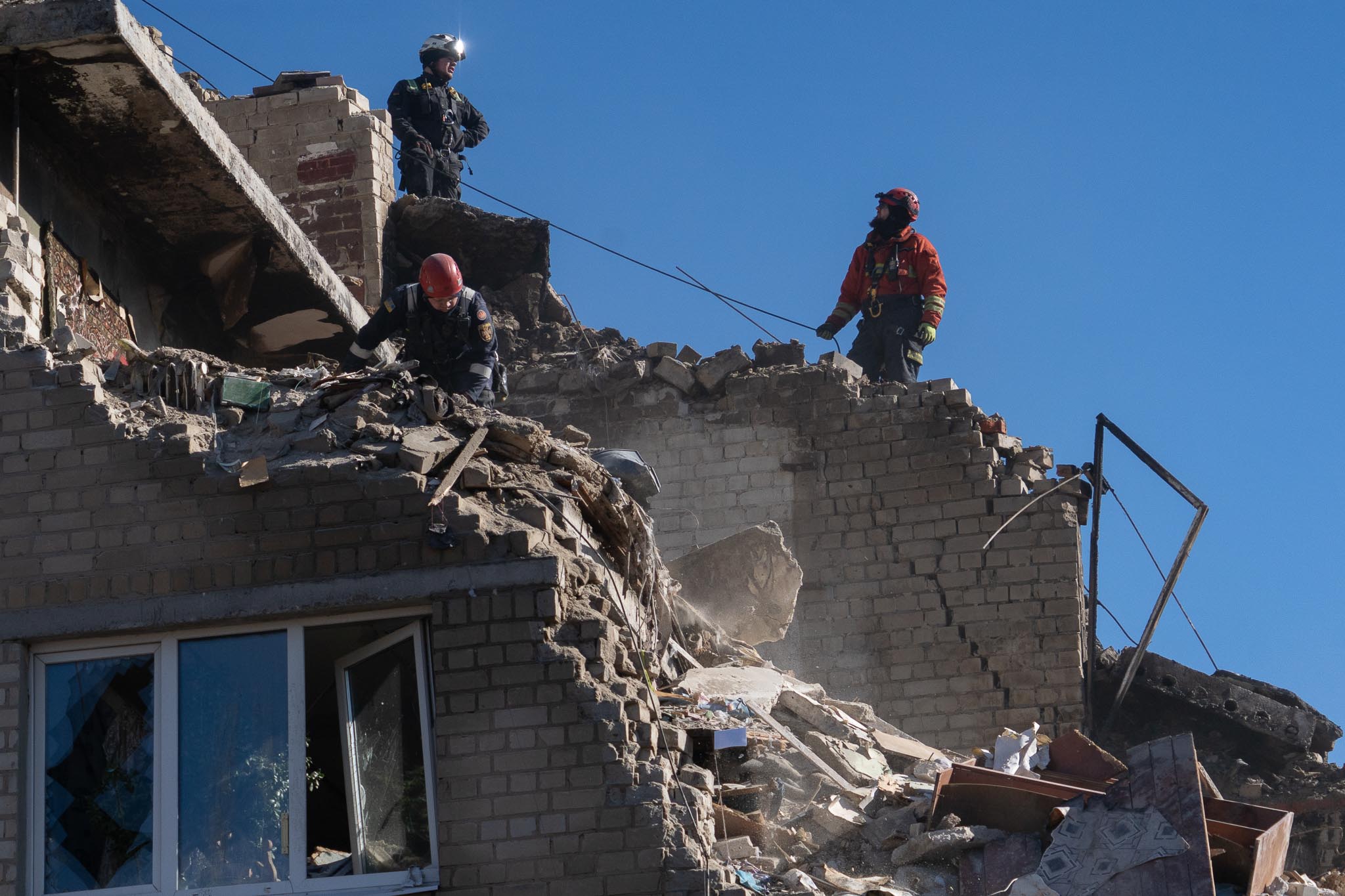
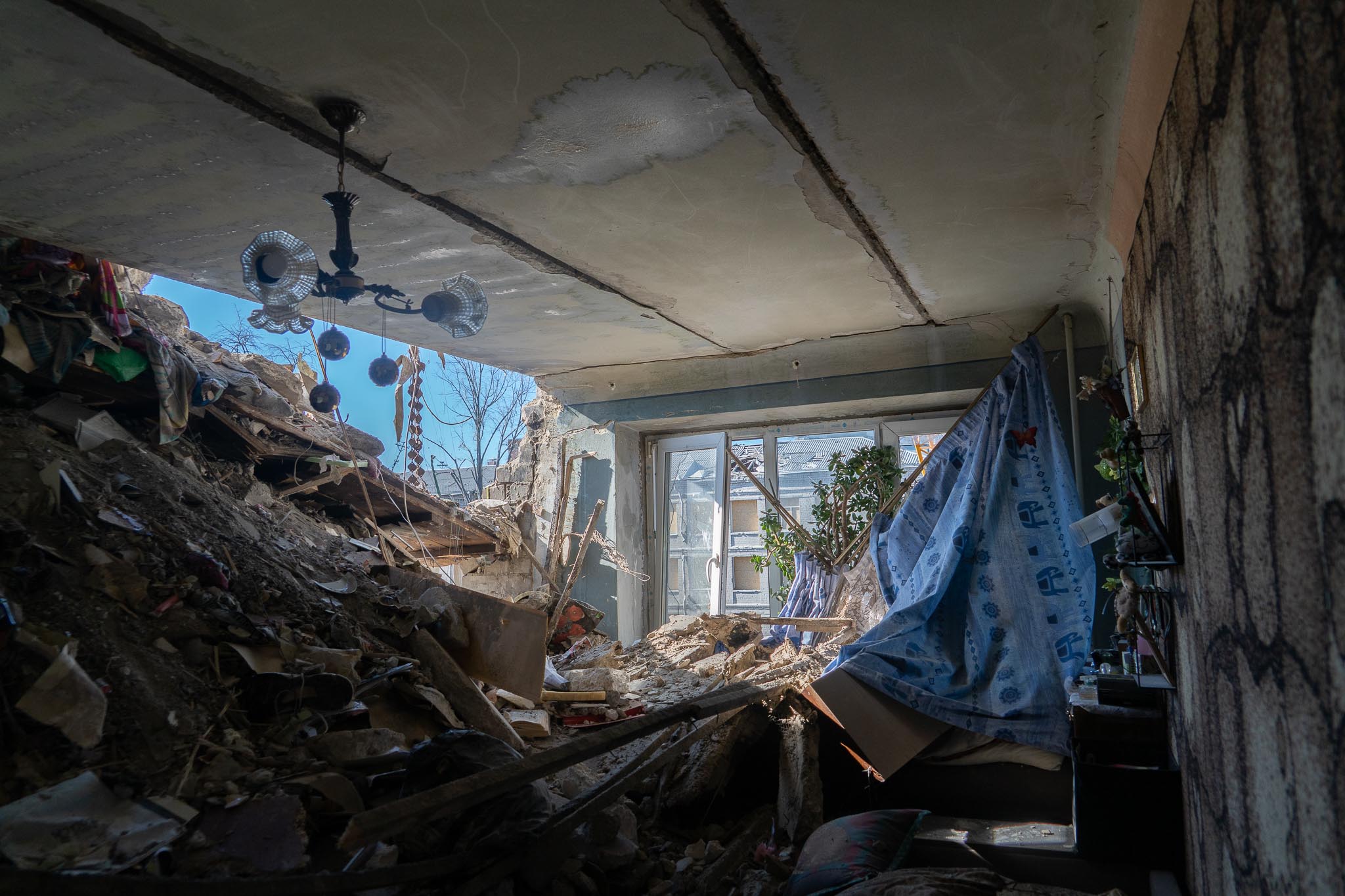
With the fire gone, I get inside the building that was the epicenter of the attack, too. One of the rescuers on the break lets me borrow his helmet. He and his colleagues look tired.
The scale of destruction wrought by the Russian strike isn’t the only reason the operation lasts for this long. Each time there’s a risk of a new airstrike on Kharkiv, emergency workers stop and are supposed to go to the shelter. Russia often employs double-tap tactics — hits the first responders gathered at the impact site second, third time.
“Ballistics from Taganrog! Everyone get off the street!”
This time, the missile Russia launches hits Lozova, a city in the south of Kharkiv region, according to monitoring channels.
A group of emergency workers goes to hide from the attack in school, but, as they enter, they laugh at the decision: the school doesn’t have a basement, and being on the first floor of an educational facility — a type of building Russia often targets — isn’t the best protection.
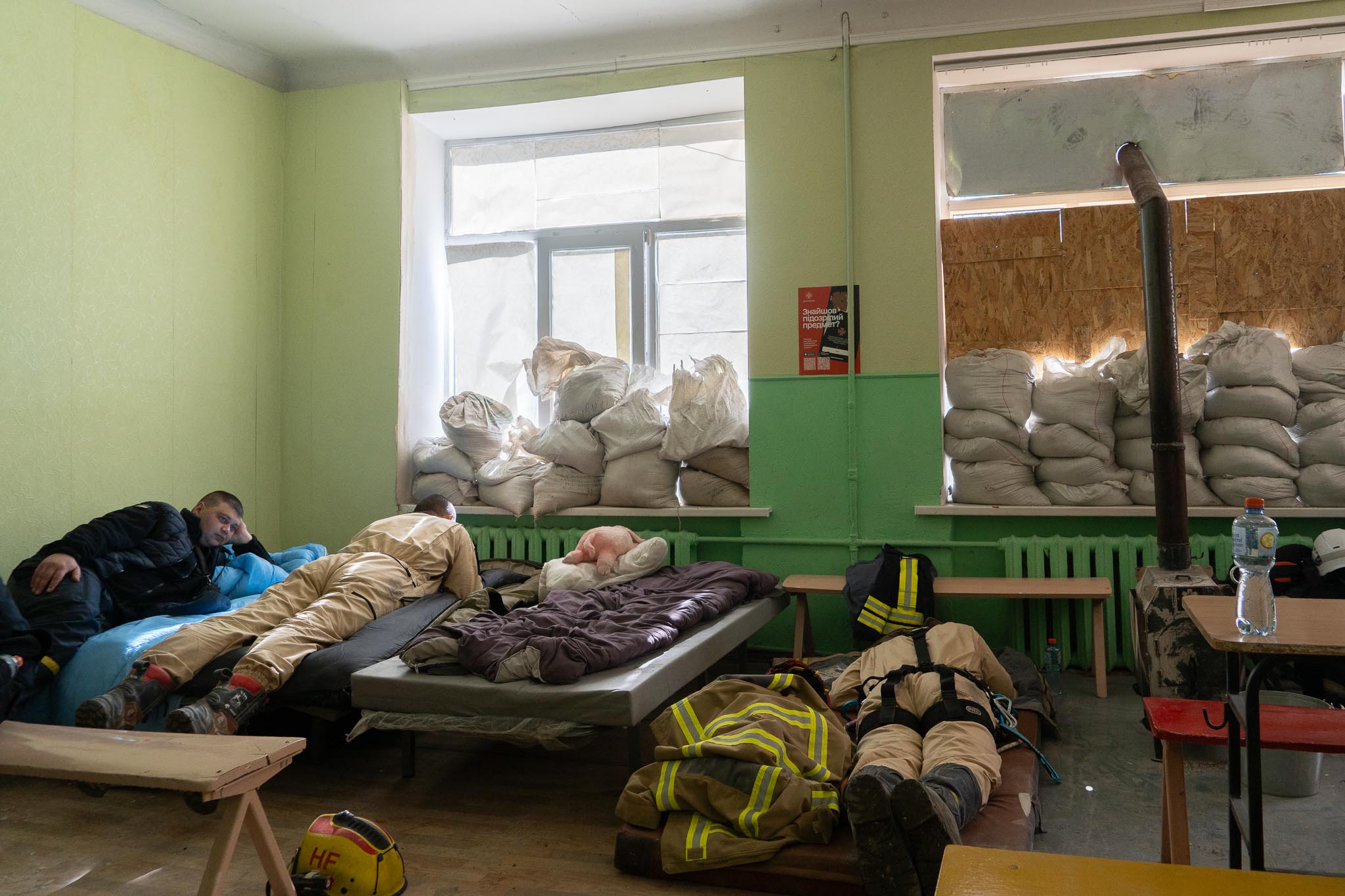
Still, they gather in the school’s “invincibility point.” Some of their co-workers are sleeping right there. As I’m writing this piece, it’s close to 00:00 on Mar. 10, and the search operation in Kyivskyi district of Kharkiv is still not finished.
Hi, it’s Yana, author of this article. Me and my colleagues Liubov, Daria, and Serhii worked through the weekend to cover the consequences of this deadly Russian attack — thank you for reading this piece and caring about Kharkiv. If you want to support our on-the-ground reporting from the city, please consider a one-time donation or join our community.
Read more
- “We didn’t even have time to get scared.” Kharkiv recovers after another overnight Russian drone, missile attack
- Kharkiv locals mourn those killed in Russia’s war against Ukraine as the 5th year of full-scale invasion begins


Subscribe to news from Kharkiv, Ukraine
Most important stories from the frontline region