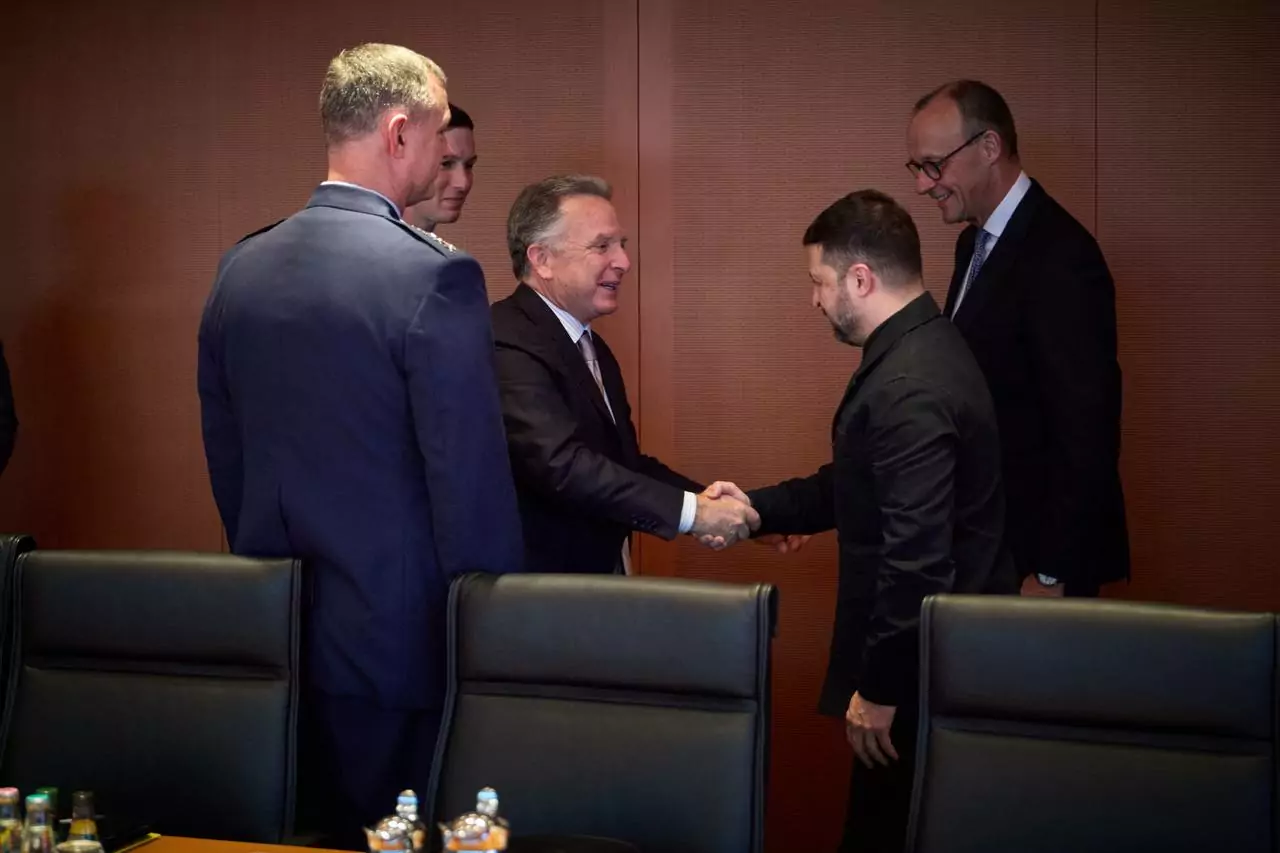
On Dec. 14, in Berlin, Ukraine and the US discussed a potential peace deal with Russia. Volodymyr Zelenskyy, President of Ukraine, headed the Ukrainian delegation. On the American side were Steve Witkoff, Trump’s special envoy to Kyiv, and Jared Kushner, son-in-law and the adviser of the US President.
The WSJ reported that the negotiations were difficult and that the American side once again tried to pressure Ukraine into withdrawing its troops from the parts of Donetsk region Russia didn’t occupy.
The US even resorted to an unexpected proposal. The American delegation offered Ukraine security guarantees from the US similar to Article 5 of NATO, i.e., guarantees that would compel America to give a “military response” if Russia attacked Ukraine again. However, the American side said that such a proposal would not remain on the table indefinitely and that Ukraine had limited time to make a decision.
Ukraine confirmed that it’s open to compromise on security guarantees as well. President Zelenskyy has reportedly said that Ukraine’s willing to give up its hopes of joining NATO in exchange for security guarantees.
“And above all, (the peace plan) must be workable. The plan truly should not be just a piece of paper, but a meaningful step toward ending the war,” said Zelenskyy.
The Guardian also wrote that European leaders perceived US-Ukraine talks in Berlin as the one that do really defend Ukraine from future Russian aggression. They were particularly optimistic about security guarantees.,
Following the talks in Berlin, European leaders issued a joint statement presenting such guarantees for Ukraine:
- A European-led “multinational force” to support Ukraine’s army and defend its skies and seas.
- A “legally binding commitment” from the UK and other European nations to “take measures to restore peace and security in the case of a future armed attack”.
- European support for Ukraine’s accession to the EU.
- “Sustained and significant support” from Europe to help Ukraine “build its armed forces”, which should remain at a peacetime level of 800,000 troops (Russia has demanded that Ukraine cut the size of its armed forces of 600,000 troops).
- A US-led “ceasefire monitoring and verification mechanism” to “provide early warning of any future attack”.
- Investment in Ukraine’s reconstruction, which may include Russian sovereign assets that have been frozen in Europe.
Still, a lot of questions about how to make the peace deal happen are still up in the air. Ivan Marchenko, Doctor of Economics, Associate Professor of the Department of International Relations at Kharkiv National University, notes that Ukraine has effectively rejected the terms proposed by Kushner and Witkoff regarding the surrender of the Donetsk region, and Russia is unlikely to accept the Ukrainian side’s amendments, which paves the way for a new round of negotiations.
Uncertainty of response
On Dec. 18, President Zelenskyy said that he did not fully understand how the security guarantees would work. He added that Ukraine was not yet ready to assess the effectiveness of the guarantees, noting that it was necessary to crystallize the main point — how the US and Europe will act if Russia attacksed again, and what kind of response there would be.
Zelenskyy also said that it is important for Ukraine to receive this response in writing, even if it is not made public.
Trump has consistently said that he will not send American troops to Ukraine. Instead, American guarantees reportedly outline how the United States plans to utilize its extensive intelligence systems to monitor the ceasefire and detect any Russian activity aimed at re-entering unoccupied parts of Ukraine, according to officials. Additionally, the US will assist in verifying Russia’s compliance with the ceasefire and ensure that “minor skirmishes” between Russia and Ukraine do not escalate into a new war.
Markus Reisner, an Austrian military historian and lecturer at the military academy in Wiener Neustadt, notes that such an unexpected and rapid proposal from the Americans regarding security guarantees seems suspicious. In his opinion, Trump’s team may not take these guarantees seriously, viewing them as similar to the 1994 Budapest Memorandum. The Memorandum provided Ukraine with security guarantees from the US, Russia, France, and Britain in exchange for renouncing nuclear weapons, but it was non-binding legally and then violated by Russia.
Ihor Marchenko also thinks that the guarantee mechanism proposed by the US seems to be a real compromise, but its implementation remains questionable. He says there is a big difference between collective security provided by all NATO members and security guarantees provided by America only. Such guarantees may simply not be implemented by the US.
He also notes that for Russia, Ukraine’s non-accession to NATO is a key condition on a par with the withdrawal of Ukrainian troops from the Donetsk region. Therefore, there is a possibility that realistic and reliable security guarantees for Ukraine, similar to Article 5 of NATO, will be perceived by Putin as Ukraine’s de facto accession to the alliance, which will lead to another rejection of the peace process by Russia
Ihor Marchenko also said that EU accessio cannot be a military security guarantor for Ukraine because is an economic alliance.
“So when they combine them, saying that if you reject NATO, you automatically join the European Union, that’s a kind of substitution, where instead of hot, we get red,” Marchenko says.
Andrius Kubilius, European Commissioner for Defense, spoke more about European security guarantees during the summit on December 18. He added that Germany, France, Italy, the United Kingdom, and Poland are still discussing possible formats of security guarantees for Ukraine. One of the conditions he mentioned was the possible redeployment of these countries’ troops to NATO territory.
German Chancellor Friedrich Merz spoke about such a prospect as well. He noted that a peace agreement could indeed provide for the deployment of peacekeeping forces, adding that Europeans may have to repel Russian attack if they decide to invade Ukraine again.
This scenario seems unlikely, as Russia has repeatedly declared the deployment of any foreign troops on Ukrainian territory unacceptable.
However, it will be a major victory if Ukraine can secure ratification of security guarantees in the US Senate that will provide Ukraine with weapons, training for soldiers, and intelligence, says Mykola Bielieskov, an analyst at the National Institute for Strategic Studies of Ukraine.
Issue with joining NATO
Another important aspect of the Berlin negotiations is Ukraine’s refusal to join NATO. In 2019, just a few months prior to the presidential election, Ukraine amended its Constitution to formally commit to EU and NATO membership as a strategic goal. This amendment was defined by a law passed by the Verkhovna Rada on February 7, 2019, highlighting Ukraine’s desire for integration into Euro-Atlantic structures as an irreversible process.
Mark Rutte, NATO Secretary General, said that the alliance has no consensus on Ukraine’s accession, but emphasized the Washington Treaty, which states that any sovereign democratic state can apply for membership in the alliance.
“The practical situation is that, as you know, Ukraine’s accession to NATO requires the consensus of all allies. And now, as you know, there is no consensus on Ukraine’s accession to NATO,” Rutte said in response to a question about Ukraine’s future membership in the alliance.
Zelenskyy’s statements about seeking compromises were met with criticism from the Ukrainian opposition. “If this is true, then it is an abuse of Zelensky’s constitutional powers, for which the Ukrainian people did not give him any mandate. Victory for Ukraine means preserving our sovereignty,” says Iryna Gerashchenko, a Ukrainian MP and member of former President Petro Poroshenko’s party.
In order to amend Ukraine’s constitution, a referendum on withdrawal from the NATO course should be held. That is currently impossible due to martial law, but President Zelenskyy ordered Ukrainian parliamentarians to draft a law that would guarantee elections in Ukraine during wartime.
Zelenskyy’s decision be more of a performance to show that Ukraine seriously understands the threat to democracy and is considering options for holding these elections not only democratically, but also without or with minimal threats of manipulation from Russia, which will not undermine Ukraine’s sovereignty and state order, suggests Kateryna Bousol, a Ukrainian lawyer and associate professor at the National University of Kyiv-Mohyla Academy.
Busol adds that Ukraine’s Euro-Atlantic and European integration course is not just a policy of wishes, but Ukraine’s strategy enshrined in the Constitution. Western countries such as Britain and the US often refer to late 19th century norms and emphasize that even after more than a century, they remain relevant to their laws.
In her opinion, Ukraine should also defend a similar position for its Constitution: to show that, although the state is open to seeking legislative and legitimate solutions, but to also emphasize that the Ukrainian constitution is not just a “piece of paper,” and it cannot be changed every six months.
Busol also talks about possible compromise solutions. She explained that, according to the Constitution of Ukraine and the law on international treaties, an international treaty ratified by the Verkhovna Rada takes precedence over national legislation if its provisions differ from the Constitution or other norms. Busol said that this rule applies only to ratified documents, not to those that have simply been signed.
The lawyer said that the potential referendum might involve authorities discussing the need for an interim decision. The authorities could also say that Ukraine has ratified this international treaty (if such a treaty — that includes a US Article 5-like security guarantee — is signed) and that its provisions are therefore binding.
Using Colombia as an example, she said that the first peace agreement reached within the armed conflict took a really long time to agree upon. The Colombian people did not support the agreement between the government and the FARC rebels, even though it was negotiated, as Busol put it, with their blood and sweat. A new round of negotiations then started.
“Signing peace agreements, of course, is very important, but the processes that follow can also influence whether the agreement will be implemented at the national level and in what format, and whether there will be a review, as was the case in Colombia, for example.”
Read more
- “I won’t go through occupation again” — life in Ukrainian village one mile from Russia
Hello, this is Nazar, the author of the article. I was extremely interested in telling you about the possible security guarantees for Ukraine that are being talked about so much. If you are interested in learning more about such events with the opinions of Ukrainian experts, please buy us a coffee or consider subscribing to our Patreon.


Subscribe to news from Kharkiv, Ukraine
Most important stories from the frontline region