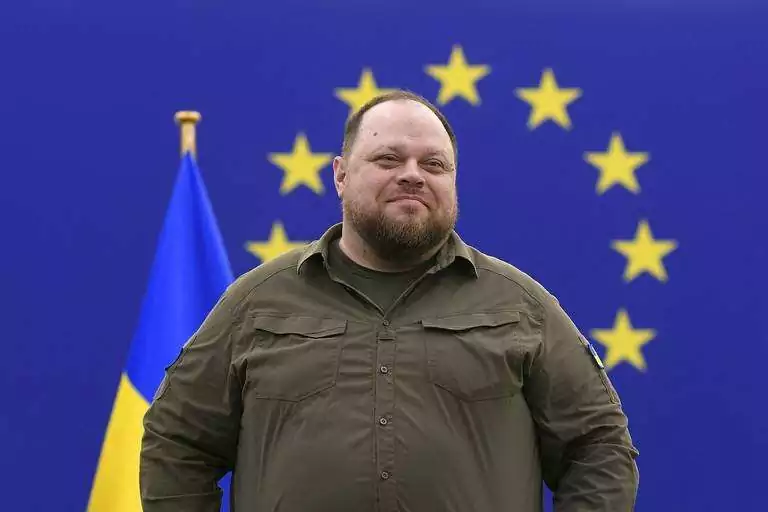
UKRAINE — On Jan. 22, Ruslan Stefanchuk, the speaker of Verkhovna Rada (Ukrainian parliament), along with a large group of Ukrainian lawmakers, submitted a draft of revised Civil Code of Ukraine for consideration.
A key feature of the new Civil Code is the expansion of its scope. On Jan. 23, Stefanchuk outlined the main changes, saying family law will now be integrated into the code and “harmonized with the general institutions of private law.” He added that the new draft introduces a child-centered approach.
In the explanatory note the authors of the draft say that the new Civil is intended to “harmonize” Ukrainian laws with European legal regulations and unification acts.
“The new Civil Code is not about abstract reform, but about understandable and modern law for everyday life,” Stefanchuk said.
The submitted Code was criticized by the Ukrainian human rights organizations, in particular for its homophobic and transphobic provisions. In their joint statement. Ukrainian NGOs say that the draft undermines EU accession requirements.
Under the current Family Code of Ukraine, a family is defined as people who live together and share responsibilities. This includes married couples, which under Ukrainian law must be heterosexual, as well as people who live together as a family without formal marriage.
This wording allowed Zorian Kis and Timur Levchuk to get their de facto marital relationship recognized by the Ukrainian court. In June 2024, Kis was appointed first secretary at the Ukrainian Embassy in Israel. He sought to take his partner with him on a long-term posting, but the Ukrainian Ministry of Foreign Affairs refused, citing national law that recognizes only unions between a woman and a man as marriages. The couple then appealed to a court, which, taking into consideration the evidence that they lived together since 2013, held a civil wedding ceremony in Ukraine in 2017, and officially married in the United States in 2021, recognized their relations as marital.
The renewed Civil Code introduces amendments that define a family as the cohabitation of a man and a woman exclusively. According to human rights organizations, this practice undermines established case law (e.g. Kis and Levchuk’s case) and closes the only legal avenue that allows same-sex couples to protect their family rights.
“This represents more than just stagnation in the field of human rights or a lack of progress on the European integration path; it is an actual legal regression,” NGOs said in a joint statement, published by Zmina, a Ukrainian organization organization that monitors human rights abuses.
Another proposed amendment would annul marriages with a person that undergoes legal sex reassignment. Currently, Ukrainian law relies on sex markers in official documents, and while such couples cannot renew their marriage certificates after a gender change, they are not required to dissolve their marriages. Those marriages would be automatically annulled if a new Civil Code is signed into law.
Human rights groups were also concerned by the amendment that allowed marriage in Ukraine from age 14 if a girl is pregnant or has already given birth, provided a court grants a couple permission to marry.
On Feb. 6, Speaker Stefanchuk said the provision would be removed from the draft. He claimed that the authors had sought to ensure that the best interests of a child the 14-year-old is pregnant were taken into account. According to Stefanchuk, the provision was intended to allow a newborn to remain in a “loving family” regardless of the circumstances.
“The working group sees that society perceives this provision ambiguously. So we decided to exclude it from the draft,” Stefanchuk added.
However, as of Feb. 12, Ruslan Stefanchuck didn’t react to NGO’s criticism about provisions in the draft Civil Code that violates the rights of same-sex couples.
Ukraine’s commitments for EU accession
Anna Sharyhina, head of KyivPride, an organization that advocates for LGBTQ+ rights, provided Gwara Media with a legal analysis of the family law provisions in the draft Civil Code. Experts say that although the update was intended to align with European practices, it contains no provisions protecting same-sex couples, despite Ukraine’s obligations to the European Union.
Legal analysis indicates that this obligation was established for Ukraine by the European Court of Human Rights on Jun. 1, 2023, in Maymulakhin and Mark v. Ukraine, which found that the lack of recognition or protection for same-sex relationships violates Articles 8 and 14 of the European Convention on Human Rights.
On May 14, 2025, Ukraine approved a roadmap for the rule of law outlining necessary reforms under Sections 23 (“Judicial System and Fundamental Rights”) and 24 (“Justice, Freedom, and Security”). Paragraph 3.11, “Discrimination against members of the LGBTQ+ community,” identifies measures that would makeUkrainian law and practice comply with European standards. One of the roadmap’s strategic directions calls for ensuring equal rights for LGBTQ+ people through the introduction of registered civil partnerships, with a deadline for implementation in the third quarter of 2025.
However, no laws protecting the rights of LGBTQ+ people have been passed by the Verkhovna Rada.
Inna Sovsun, a Member of Parliament from “Holos,” a liberal opposition party, told Gwara that although Ukraine had ratified the roadmap, the European Council had not done so. As a result, the roadmap currently reflects Ukraine’s political will but does not carry any legal obligations.
“Because of this, some people on the Ukrainian side believe that they are not (legally) binding,” Sovsun said.
The legal analysis also notes that Ukraine’s integration into the EU will require it to follow the practice of the European Court of Justice. For example, the Coman case obliges member states to recognize same-sex marriages made in other EU countries for residency purposes. The more recent Wojewoda Mazowiecki case extends this obligation to all marriages, even if both spouses are citizens of a country where same-sex marriage is not allowed.
The European Parliament also urged Ukraine to adopt bills 9103 and 12252, introduced by MP Inna Sovsun in 2023 and 2024 respectively to establish civil partnerships in Ukrainian law and provide legal recognition and protection for same-sex couples. As of 2026, voting on these bills still did not take place.
Proposals from draft critics
Sovsun said that same-sex relationships should also be recognized as family relationships. She emphasized that the discussion was not about marriage, which isn’t legal for same-sex couples and impossible to legalize now because Ukraine cannot amend the Constitution during the martial law, but about relationships that qualified as familial or marital. She noted that, aside from returning to the status quo, the Civil Code could include a framework for civil unions or de-facto marriages.
Sovsun added that, for example, a resolution from Ukraine’s government could specify that a family may be formed as a civil union. That, she thinks, can reduce pressure on the Parliament and “depoliticize” the issue. Then, it would also be possible to extend the existing legal norms to same-sex partnerships.
All people who share a household and mutual rights and obligations should be recognized as family members, removing outdated requirements for blood relations, Sviatoslav Sheremet, Policy and Legislation Coordinator of the National LGBTI Consortium, told Gwara. He criticized the draft’s limitation of marriage to opposite-sex couples, noting it could prevent Ukrainians from entering same-sex marriages abroad, something that, according to him, at least 5,000–10,000 couples have already done.
Sheremet also called for the removal of a discriminatory provision that would annul marriages if one spouse changes their legal gender. He stressed that Ukraine should recognize marriages performed abroad without restrictions on gender, while pointing out the inconsistency of recognizing foreign same-sex marriages but not those of Ukrainian citizens.
The LGBTQ+ military, the human rights organization that stands up for LGBTQ+ military servicemembers and opposes the draft Civil Code, tells the story of a soldier, Dmytro Liaskovetskyi, and his boyfriend, Evehenii Donets.
Liaskovetskyi has been living with his boyfriend for eight months. Now the couple is trying to achieve recognition of their relationship through the court.
For them, as for many other LGBTQ+ couples, the current Family Code is the only way to recognize the nature of their marital relationship, because the Sovsun’s bills on civil partnerships have not yet been voted on in Parliament.
“If something happens to me, Evhenii is not legally a member of my family. If I die, he will not receive any compensation. It seems completely unfair,” says Dmytro. If the draft Civil Code is passed, this avenue of state recognizing their relationships will be closed.
Officials’ reaction to criticism of the draft of Civil Code
“Our colleagues who communicate with the MPs who initiated the bill say that some of them were not fully aware of the harm they were causing to the LGBTQ+ community,” Anna Sharyhina said when asked about the officials’ reaction to criticism.
Sviatoslav Sheremet , told Gwara that their working group works alongside ministries and agencies that prepare for Ukraine’s EU accession negotiations. Government officials have assured him that the analysis of the draft Civil Code will be carefully conducted and submitted to parliament. That, Sheremet believes, reflects genuine readiness for dialogue. He says that four-way exchange between the government, parliament, the public, and European institutions about the new code “lays a solid foundation for success.”
Anna Sharyhina also shared that the Security Service of Ukraine (SBU) had contacted her over her criticism of the law, but she said that KyivPride is not planning any protests, citing signals from authorities that they are open to dialogue.
On Feb. 6, Olena Kondratiuk, a deputy chairman of Verkhovna Rada and co-author of the draft Civil Code, withdrew her signature from the bill card. She explained that the “first sign” of the problems with the Civil Code were the joint statement of human rights NGOs.
“In my opinion, the most proper way to resolve issueswith the Civil Code is to withdraw it, then revise of problematic amendments and (organize) mandatory broad public discussion,” Kondratiuk said.
At the Parliament meeting on Feb. 10, the law wasn’t put for a vote. At this meeting, Inna Sovsun addressed MPs from a podium and criticized the draft Civil Code for legalization of marriages with 14-year-old children.
“This absurdity that members of the Legal Policy Committee are trying to push through goes against common sense and Ukraine’s international obligations,” she said.
At the same time Inna Sovsun told Gwara that despite strong opposition from human rights groups, the Civil Code is likely to pass its first reading without changes. However, she believes significant amendments could be made during the second reading, potentially affecting more than just family law.
“Obviously, I will not vote for him,” Sovsun added.
Ruslan Stefanchuk, speaker of Ukrainian parliament who submitted the draft of the Civil Code, didn’t respond to Gwara Media’s request to comment on the criticisms of the code and its impact on Ukraine’s EU path.
Hi, it’s Nazar, the author of the article. I know that many people are following the situation with Ukraine’s accession to the EU, and, I suppose, you are one of them, dear readerFor me it’s especially important to show the actual state of affairs with the eurointegration, even if it highlights the mistakes of Ukrainian authorities along this long path. If you want to see more articles about EU enlargement from Ukraine’s perspective, please consider buying us a coffee or becoming a long-term subscriber.
Read more
- “Train of invincibility” keeps Kharkiv rail passengers warm during coldest winter since Russia’s full-scale invasion


Subscribe to news from Kharkiv, Ukraine
Most important stories from the frontline region